
By EBV staff writer
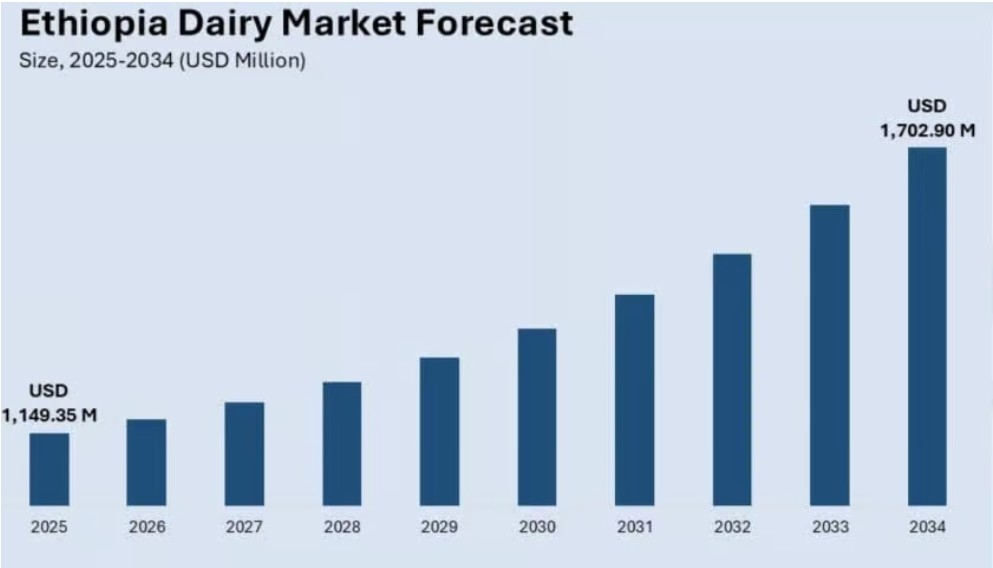
Ethiopia’s dairy market is projected to grow by 54 percent over the next nine years, driven by rising urbanization, government-led development strategies, and a surge in large-scale investments, according to a new report by Imarc Group.
The report values the country’s dairy market at US$1.1 billion in 2025 and forecasts it will reach US$1.7 billion by 2034, reflecting a compound annual growth rate (CAGR) of 4.47 percent from 2026 to 2034.
Liquid milk remains the dominant product category, accounting for 43.2 percent of the market share in 2025. Analysts attribute this to growing consumer preference for fresh, pasteurized products and the expansion of urban retail networks.
Regionally, Oromia leads the market with a 43.5 percent share, benefiting from favorable agro-climatic conditions and its proximity to major milk processing facilities.
The sector’s expansion is underpinned by increased government focus, rapid urbanization, and advancements in food processing. Investments in cross-breeding programs and processing plants are helping boost production yields and improve product quality. At the same time, rising health awareness and higher per capita incomes are shifting consumption patterns toward value-added dairy products.
In December 2023, Ethiopia launched its National Dairy Development Strategy (2022–2031), a comprehensive roadmap developed by the Ministry of Agriculture in collaboration with the International Livestock Research Institute (ILRI). The strategy aims to quadruple national milk production by 2031 and strengthen dairy value chains across the country.
International investment is also accelerating the sector’s modernization. In February 2025, Ethiopian Investment Holdings (EIH) and the Ethiopian Agricultural Business Corporation (EABC) signed a US$600 million shareholders’ agreement with UK-based private equity firm Asset Green. The partnership will develop an integrated dairy farming and processing project, including large-scale feed production and modern dairy operations—one of the largest foreign investments in Ethiopia’s agribusiness sector to date.
On the product innovation front, Holland Dairy, a major industry player, recently introduced a banana yogurt made with locally sourced Ethiopian bananas. The new product blends local flavors with dairy innovation while supporting smallholder farmers.
Challenges Remain
Despite the positive outlook, the sector faces persistent challenges. Limited availability and high costs of quality animal feed continue to constrain productivity, particularly for smallholder farmers who struggle to access improved forages and concentrate feeds.
These feed shortages contribute to seasonal fluctuations in milk production and limit the potential gains from crossbreeding programs. Additionally, underdeveloped market infrastructure—including a shortage of milk collection centers and an insufficient cold chain network—hinders efficiency along the value chain. In many rural and semi-urban areas, inadequate cooling and storage facilities result in significant post-harvest losses, while poor road connectivity further complicates the timely transport of perishable dairy products.
The predominance of indigenous cattle breeds, which produce significantly lower milk yields than crossbred varieties, also remains a constraint. Although crossbreeding initiatives are expanding, transforming the national herd will require sustained investment in artificial insemination, veterinary services, and comprehensive farmer training programs.©SECO


