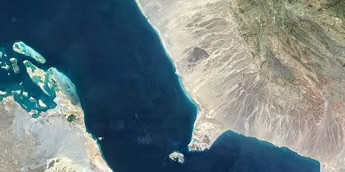
A renewed Houthi advance toward Yemen’s Red Sea coastal areas of Mocha and Dhubab is raising fresh concerns over the security of one of the world’s most important maritime trade routes, with potential consequences for Ethiopia, the Horn of Africa and global supply chains.
Four Yemeni government military sources told Reuters on Thursday that Houthi fighters were closing in on the two strategic coastal areas near the Bab el-Mandeb Strait. Any significant expansion of Houthi control along this coastline could strengthen the group’s ability to threaten commercial vessels passing through the narrow gateway between the Red Sea and the Gulf of Aden.
Bab el-Mandeb is particularly important for Ethiopia because the country’s international trade relies heavily on the Djibouti corridor. The strait connects shipping routes serving Djibouti’s ports with the Red Sea, Suez Canal and markets in Europe and beyond.
The waterway normally carries about 12% of global trade and as many as seven million barrels of oil a day, according to the Associated Press. A prolonged security crisis could therefore have consequences far beyond Yemen, potentially increasing freight rates, insurance premiums, fuel costs and delivery times.
For Ethiopia, the risk is particularly significant because a major disruption could increase the cost and complexity of goods moving through Djibouti. Imported fuel, machinery, industrial inputs, vehicles, consumer goods and other commodities could face higher transportation and insurance costs if shipping companies begin avoiding the Red Sea route.
The immediate situation, however, has not yet reached the point of a closure. Ships continue to use Bab el-Mandeb. Ship-tracking data showed that 28 commodity vessels crossed the strait on Wednesday, broadly in line with the ten-day daily average of 27 vessels, according to Reuters.
But the growing military threat could change the calculation for shipping companies and insurers even if the waterway remains technically open.
A simultaneous deterioration around Bab el-Mandeb and the Strait of Hormuz would be particularly alarming for global logistics. Only seven vessels crossed Hormuz on Wednesday, compared with a ten-day average of 14, according to the reported shipping data.
The two waterways occupy critical positions in global supply chains. Bab el-Mandeb provides the maritime gateway between the Indian Ocean and the Red Sea-Suez route, while Hormuz is a major passage for global energy shipments.
A prolonged disruption at both points could force vessels to take longer alternative routes, including around Africa’s Cape of Good Hope, adding substantial sailing time, fuel consumption and shipping costs.
The latest Houthi advance follows renewed fighting between the group and forces aligned with Yemen’s internationally recognised government. A Houthi attack on Mocha in August reportedly killed seven people and wounded 30, while fighting has intensified in recent days.
The developments are also of direct importance to the Horn of Africa. Djibouti and Eritrea lie on the African side of Bab el-Mandeb, while Djibouti serves as Ethiopia’s principal maritime gateway.
Although no African government has reported disruption to its ports from the latest advance, the escalation creates a serious risk for a logistics corridor on which Ethiopia depends heavily.
For Ethiopian importers and exporters, the immediate concern is not that Bab el-Mandeb has closed, but that rising security risks could gradually translate into higher freight and insurance costs, longer transit times and increased uncertainty across the Djibouti-Ethiopia trade corridor.
The greatest danger for global logistics would come if attacks become frequent enough to make major shipping companies reconsider the Red Sea route altogether.
For Ethiopia, any sustained diversion of vessels away from the Red Sea could ultimately increase the cost of bringing goods into the country and put additional pressure on businesses already facing high logistics and foreign-exchange costs.