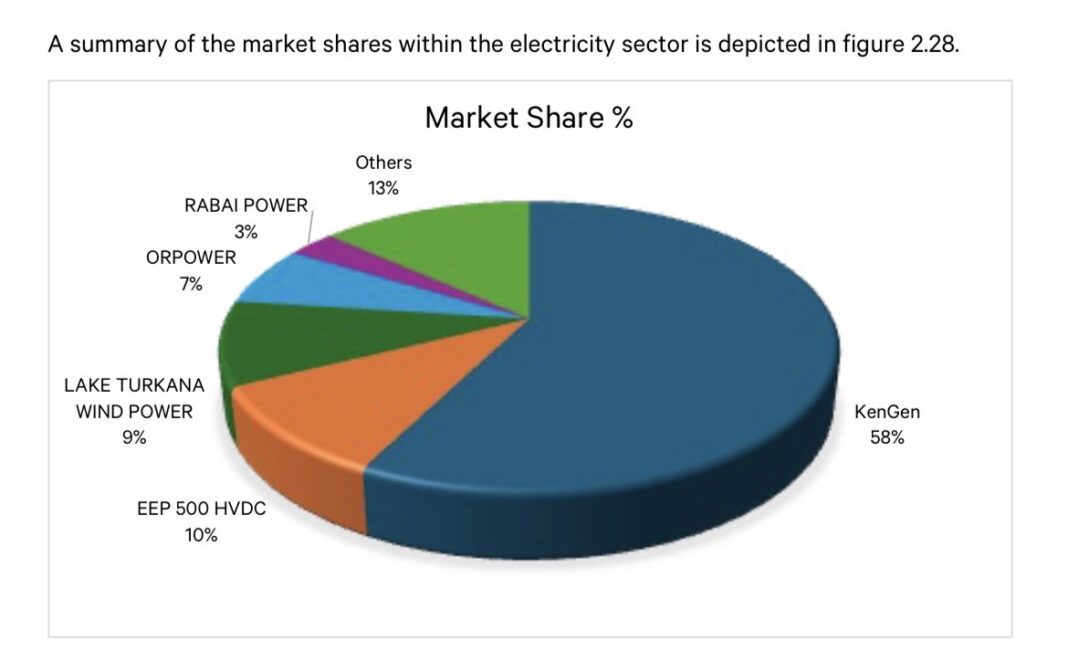
Kenya’s electricity generation market remained under KenGen’s control in the year ended 30 June 2026, with the state utility accounting for 57.52 percent of total supply, according to the Energy and Petroleum Regulatory Authority’s latest statistics report. KenGen generated 8,974 gigawatt-hours of the approximately 15,601 gigawatt-hours recorded, preserving its position as the clear market leader even as its share continued a slow decline from nearly 63 percent five years earlier.
The strongest challenge to that dominance came from Ethiopia. Electricity imported from the neighbouring country reached 1,585 gigawatt-hours, giving Ethiopia a 10.16 percent overall market share and second place behind KenGen. More significantly, Ethiopia supplied the overwhelming majority of Kenya’s cross-border power. Of the 1,913.66 gigawatt-hours Kenya imported during the year, 1,577.66 gigawatt-hours arrived through the interconnection with Ethiopian Electric Power, representing 82.45 percent of all electricity imports. An additional 7.41 gigawatt-hours was delivered by the Ethiopia Electric Utility to Moyale, bringing Ethiopia’s combined share of Kenya’s imported power to approximately 83 percent. This marked a sharp rise from just 2.68 percent of Kenya’s total supply in 2021/22 and confirmed Ethiopia as by far the largest external source of electricity.
Lake Turkana Wind Power held third place with 9.40 percent, followed by Orpower 4 at 6.63 percent. Independent power producers and imports together now exceed 42 percent of generation, reflecting gradual diversification. The Herfindahl-Hirschman Index edged lower to 0.357 from 0.375 the previous year, indicating a modest improvement in competition, though the market remains highly concentrated.
Overall generation rose 8.44 percent to 15,692.81 gigawatt-hours, while peak demand hit a record 2,514.28 megawatts. Renewable sources continued to dominate the mix at more than 81 percent. Looking ahead, the next phase of the power purchase agreement with Ethiopian Electric Power is expected to increase imports from the current 200 megawatts to 400 megawatts through the 500-kilovolt HVDC link, further strengthening Ethiopia’s already dominant position in Kenya’s import portfolio and deepening regional energy integration.SECO