By EBV staff writer
A new report from the World Inequality Lab, the World Inequality Report 2026, reveals that global inequality has reached staggering new heights, with profound consequences for economic stability, climate justice, and social cohesion worldwide. The findings underscore a deepening crisis in Sub-Saharan Africa and expose structural imbalances that transfer resources from poor to rich nations.
The world’s economic resources are overwhelmingly concentrated among a tiny elite. The richest 10% of the global population now earns 53% of all income and owns 75% of all wealth. In stark contrast, the poorest 50% earns just 8% of income and owns only 2% of wealth. This concentration is accelerating at the very top: approximately 56,000 individuals (the top 0.001%) now possess three times more wealth than the poorest half of humanity combined.
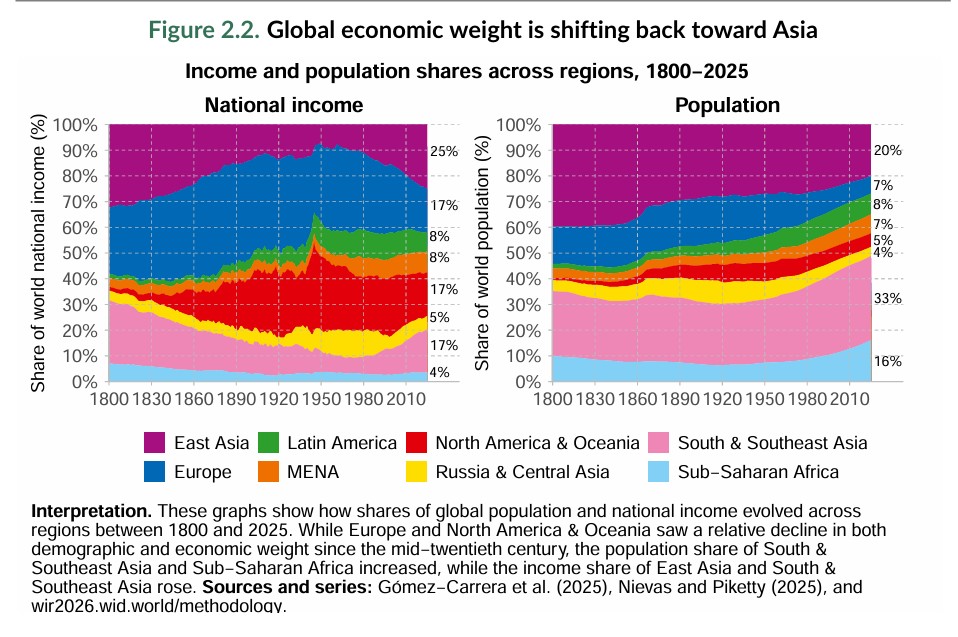
The report details a severe and worsening situation in Sub-Saharan Africa. The region’s share of global income has fallen from 7% in 1800 to just 4% in 2025. It remains the world’s poorest region, with average monthly incomes of €300, compared to €3,800 in North America and Oceania. Extreme internal inequality compounds this, as the bottom 50% of Africans earn only 8–11% of national income. A catastrophic education spending gap entrenches this disadvantage for future generations, with public investment per child at only €220, versus €9,025 in North America & Oceania—a ratio of more than 1 to 40.
The analysis identifies a key structural driver: the global financial system creates an “exorbitant privilege” for wealthy nations. Roughly 1% of global GDP flows annually from poorer to richer countries through financial channels—a sum about three times the total flow of official development aid. This persistent drain of resources systematically undermines progress in the developing world.
The report pioneers a direct link between wealth and carbon emissions, framing the climate emergency as a core issue of injustice. The top 10% of the global population is responsible for 77% of emissions associated with private capital ownership, while the bottom 50% accounts for a mere 3%. This disparity means those who contribute least to the problem are disproportionately suffering its worst effects.
When unpaid domestic and care work is counted, the true scale of gender inequality is exposed. Globally, women earn only 28% of total labor income, a figure stagnant since 1990. Including unpaid work, women work an average of 53 hours per week compared to men’s 43 hours, yet their hourly income plummets to just 32% of men’s, revealing a systemic devaluation of women’s contributions.
Economic divides are reshaping democracies, fracturing traditional class-based politics and replacing them with stark territorial divides between urban centers and smaller towns. Furthermore, political donations are heavily concentrated among the richest citizens, amplifying elite voices and marginalizing the working majority, making redistributive reforms increasingly difficult to enact.
The report concludes that such extreme inequality is a political choice, not an inevitability. It calls for a suite of proven policies to reverse these trends, including progressive taxation like a global minimum wealth tax on the ultra-rich; massive investment in free, high-quality education and universal healthcare; climate policies that tax high-carbon investments and luxury consumption; recognition and redistribution of unpaid care work through childcare and parental leave; and reforming the global financial system to stop the drain of resources from poor to rich countries.©SECO