By EBV staff writer
A devastating drought in the Horn of Africa has triggered a major humanitarian emergency, with an estimated 20 to 25 million people across Somalia, Ethiopia, and Kenya in urgent need of food assistance.
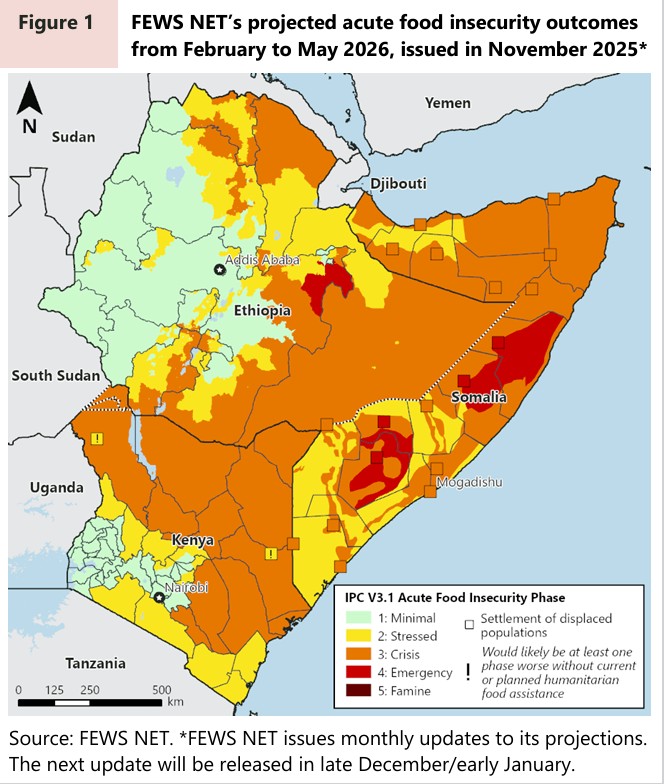
According to a new alert from the Famine Early Warning Systems Network (FEWS NET), drought is the primary driver of need for over half of this vulnerable population. The crisis is centered in eastern Ethiopia, parts of Somalia, and Kenya, where one of the driest October-December rainy seasons on record has unfolded.
The extreme dry conditions, fueled by La Niña and a strong negative Indian Ocean Dipole, are severely crippling agriculture and livestock production. This new drought comes less than three years after the region’s historic drought from 2020-2023, leaving communities with no time to recover.
“The situation is rapidly deteriorating,” the FEWS NET statement warned. “Without a scale-up of food, water, and nutrition assistance, Crisis and worse outcomes will become increasingly widespread through May.” The agency highlighted that multiple areas in Somalia are already facing “Emergency” outcomes, with rising malnutrition and outright starvation imminent.
The current disaster follows a pattern of failed rains. The recent poor season succeeded erratic spring rains and a scorchingly hot dry period. Compounding the lack of rain, extreme heat has rapidly dried up water sources and scorched vegetation. Many water points are near dry, and pasture conditions in the worst-hit areas are below 60% of normal levels.
In Ethiopia’s Somali region, critical grazing zones are parched. In Somalia, current rangeland conditions are reported to be worse than during two previous historic droughts.
While humanitarian plans are based on hopes for average spring rains, long-range forecasts are uncertain. FEWS NET warned that if the crucial March-to-May rains in 2026 also fall below average, acute food insecurity will “worsen considerably,” deepening an already catastrophic situation.©SECO