By EBV staff writer
Treasury bill yields in Ethiopia have shown a broad downward shift across short and medium maturities between July 2025 and January 2026, signaling improving financing conditions, though the long end of the curve remains elevated and price-sensitive, according to the latest Monthly Domestic Debt Bulletin released by the Ministry of Finance.
The report indicates that the government has successfully lowered borrowing costs on short-term instruments amid sustained investor appetite, even as demand for one-year paper continues to require a significant yield premium.
Short-term yields posted the most consistent declines. The yield on the 28-day Treasury bill fell by nearly four percentage points, from 15.83% in early July 2025 to 12.00% by January 21, 2026. Similarly, the 91-day yield dropped from 17.79% to 13.19% over the same period, while the 182-day tenor eased from a peak of 18.95% in July to 14.65% in late January.
Authorities attributed the sustained decline to heavy oversubscription in these maturities, which enabled the government to secure financing at progressively lower costs.
In contrast, the 364-day yield remained the most volatile segment of the curve. After opening at 14.98%, it surged to 20.00% in September before moderating to 17.02% by January 21. The persistently higher yields at the one-year tenor reflect weaker and more price-sensitive demand, consistent with the 80% subscription rate recorded in 364-day auctions.
“Investors continue to demand a significant yield premium to lock funds for longer periods,” the bulletin noted, highlighting the upward-sloping yield curve where longer-term rates price in inflation expectations and liquidity risk.
Despite the divergence in tenor performance, overall auction activity remained robust. Between July 2025 and January 2026, the government raised 527 billion birr through Treasury bill issuances across 15 auctions, attracting total bids of 846 billion birr against 525.32 billion birr offered—an oversubscription rate of 161%.
Cumulative net domestic debt issuance—comprising Treasury bills and the five-year bond—reached 81% of the annual target for the 2025/26 fiscal year. The remaining financing space under the annual ceiling stands at approximately 39 billion birr, implying an average monthly net issuance of 7.7 billion birr through June—a pace the ministry deemed operationally feasible under current market conditions, provided auction pricing discipline is maintained.
As of January 31, 2026, Ethiopia’s total outstanding domestic debt stood at 2.78 trillion birr, dominated by long-term instruments. Treasury bonds accounted for the largest component, with long-term bonds totaling 2.02 trillion birr (72.84%) and medium-term bonds reaching 202.9 billion birr (7.46%). Treasury bills comprised 424.2 billion birr (15.25%), while guaranteed domestic debt—mainly Development Bank of Ethiopia medium-term bonds and Ethiopian Electric Power loans from the Commercial Bank of Ethiopia—stood at 128.2 billion birr (4.6%).
Within the Treasury bill market, issuance remained concentrated in medium and longer tenors. The 182-day bill held the largest share at 196.2 billion birr (46.30%), followed by the 364-day bill at 136.8 billion birr (32.3%). The 91-day and 28-day bills accounted for 78.6 billion birr (18.6%) and 12.4 billion birr (2.9%), respectively.
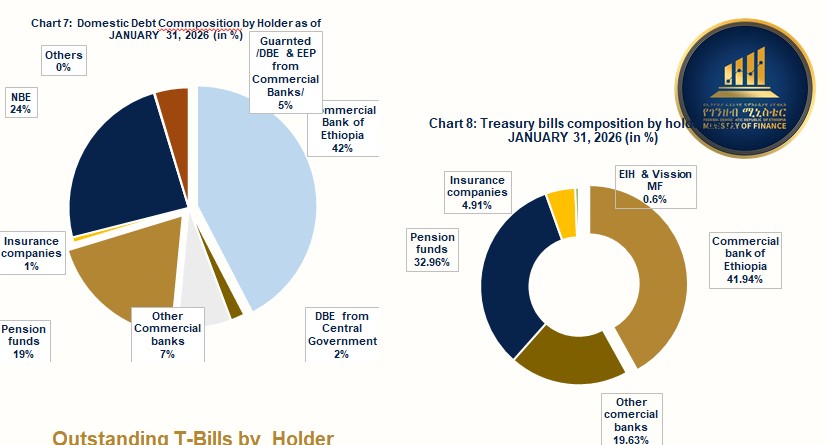
Holdings of domestic debt were highly concentrated. The Commercial Bank of Ethiopia (CBE) remained the largest holder with 1.18 trillion birr (42.4%), followed by the National Bank of Ethiopia (NBE) with 674.7 billion birr (24.3%), and the two state pension funds with a combined 521.9 billion birr (18.8%). Together, these four institutions held 85.4% of total domestic debt.
In the Treasury bill market, concentration was similarly pronounced. CBE held 41.2% of outstanding T-bills, pension funds held 33.0%, and other commercial banks accounted for 19.6%. Overall, banks represented 61.6% of T-bill holdings, while non-bank investors—driven largely by pension funds at 36.97%, followed by insurance companies and other financial institutions—held the remaining 42%.©SECO