By EBV staff writer
Ethio-Djibouti Railway (EDR), the operator of the cross-border rail link between Ethiopia and Djibouti, has expressed interest in undertaking the transport component of the planned Bishoftu International Airport, even as Ethiopian Airlines Group (EAG) moves to structure that very segment under a project-finance model—separating it from the airport’s core construction to unlock funding for one of the country’s largest infrastructure schemes.
The airline is prepared to accommodate multiple financing options for the mobility system, which is intended to serve both passengers and employees—many of whom commute from Addis Ababa.
A group official noted that the project is treated as distinct parts, even though they fall under a single master plan. This separation lies at the heart of the Group’s financing logic. While the airport itself is being advanced through specialised aviation contractors, the railway and associated transport systems are being packaged independently, with promoters hoping this will widen the pool of financiers and technical partners.
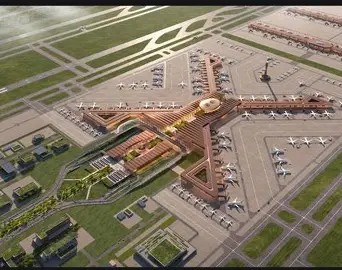
Of the project’s estimated $12.5 billion cost, $954 million is allocated to the transport segment. The broader development includes two parallel runways, an automated passenger mover, and tunnels.
The new airport is designed to link directly with Bole International Airport via dedicated road and rail connections, forming what Ethiopian Airlines executives describe as a two-airport system. The development spans 35 square kilometres of freehold land, with an additional 2.84 square kilometres secured for future expansion.
According to project officials, the rail system, access roads, depot, and passenger and cargo stations at Bole will all be bundled into a single engineering, procurement, and construction (EPC) contract.
Construction procurement has been divided into five packages. An early-works contract worth an estimated $700 million will initially be financed through Ethiopian Airlines’ equity and refinanced at financial close. Four other packages will cover infrastructure, main and support facilities, and specialised systems. The bulk of capital expenditure is expected to be procured through lump-sum turnkey contracts—a structure intended to shift construction and performance risks to contractors and enforce tighter cost and schedule discipline.
At the official groundbreaking ceremony, Prime Minister Abiy Ahmed said Ethiopian companies would have some involvement in the project. He specifically noted that the railway and adjacent expressway would be carried out by a local contractor.
EDR has stated that it would carry out the project alongside Chinese partner CCECC, which is already constructing part of the Ethiopia–Djibouti railway project inaugurated in 2018.©SECO