Key short term investments:
- 16,500 km of new MV lines
- 9,700 km of line rehabilitation and reconductoring
- 21,800 distribution-transformer interventions
- 6,945 MVA of transformer capacity additions
- USD 1.33 billion in total investment
The Ethiopian Electric Utility (EEU) plans to achieve a 99.9 percent reliable electricity supply in Addis Ababa within four years through the first phase of its newly launched 25-year Electricity Distribution Master Plan, a comprehensive initiative aimed at modernizing the country’s aging distribution network and meeting rapidly rising electricity demand.
The short-term implementation program, estimated to require USD 1.33 billion, represents the first stage of a nationwide electricity distribution roadmap extending to 2049. While the master plan covers the entire country, EEU officials say improving reliability in Addis Ababa remains the immediate priority due to growing demand pressures and persistent challenges within the capital’s distribution system.
“The primary objective of the short-term implementation is to establish a reliable electricity supply in Addis Ababa,” Chala Aman, project manager of the master plan, told EBV. “The city faces significant supply constraints, including frequent interruptions, unmet demand and customers who remain without electricity access despite being located within the capital.”

He said a large portion of Addis Ababa’s distribution network is operating beyond its original design capacity, contributing to repeated outages and limiting the utility’s ability to connect new customers or adequately serve existing demand.
“Our goal is to reduce the frequency of power interruptions by upgrading overloaded distribution feeders and bringing them back to their standard operating capacity,” Chala said.
The modernization program will introduce centralized network management systems that enable real-time monitoring of the distribution grid, allowing operators to identify faults faster and restore electricity services more efficiently.
The plan also includes the construction of alternative distribution feeders to improve network redundancy, as well as expansion of feeder capacity through additional substations to be developed by Ethiopian Electric Power (EEP). The investments are expected to strengthen network resilience and provide capacity for future demand growth.
The distribution master plan incorporates the government’s recently introduced ‘National Electrification Program (NEP 3.0)’, which targets universal, reliable and sustainable electricity access by 2035 through a least-cost combination of grid expansion and off-grid solutions.
Under NEP 3.0, EEU will serve as the lead institution responsible for planning, constructing, operating and maintaining Ethiopia’s electricity distribution system. Through the Universal Electricity Access Program, the utility will oversee grid expansion, rural electrification, new customer connections and off-grid deployment with increased operational autonomy.
On Monday July 27, EEU officially launched its 2049 Electricity Distribution Master Plan, which estimates that Ethiopia will require USD 30.6 billion in investment over the next 25 years to expand and modernize its electricity distribution infrastructure.
According to the utility, national electricity demand is projected to increase nearly ninefold, rising from around 4,300 MW currently to 39,327 MW by 2049. The growth is expected to be driven by population expansion, urbanization, industrial development and increasing adoption of electric mobility.
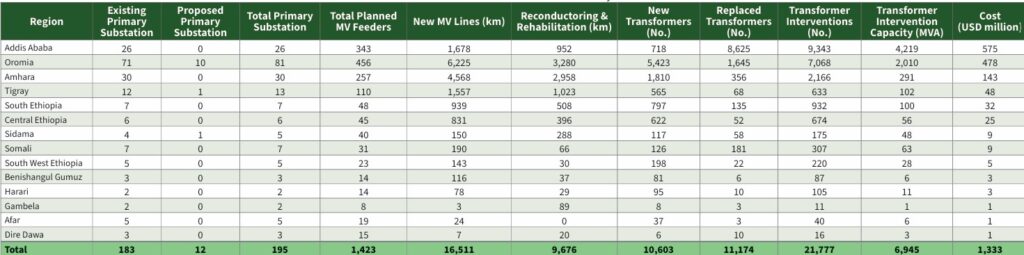
The first phase of the master plan that consume over 1.3 billion dollar includes the construction of 16,500 kilometers of new medium-voltage distribution lines, rehabilitation of 9,700 kilometers of existing lines, more than 21,800 distribution transformer interventions, and installation of an additional 6,945 MVA of transformer capacity.
EEU estimates that Addis Ababa will receive the largest share of the initial investment, with USD 575 million allocated to upgrade the capital’s distribution network. Oromia follows with an estimated allocation of USD 478 million.
Over the full 25-year implementation period, Ethiopia plans to construct 128 new substations to support network expansion and accommodate rising electricity demand.
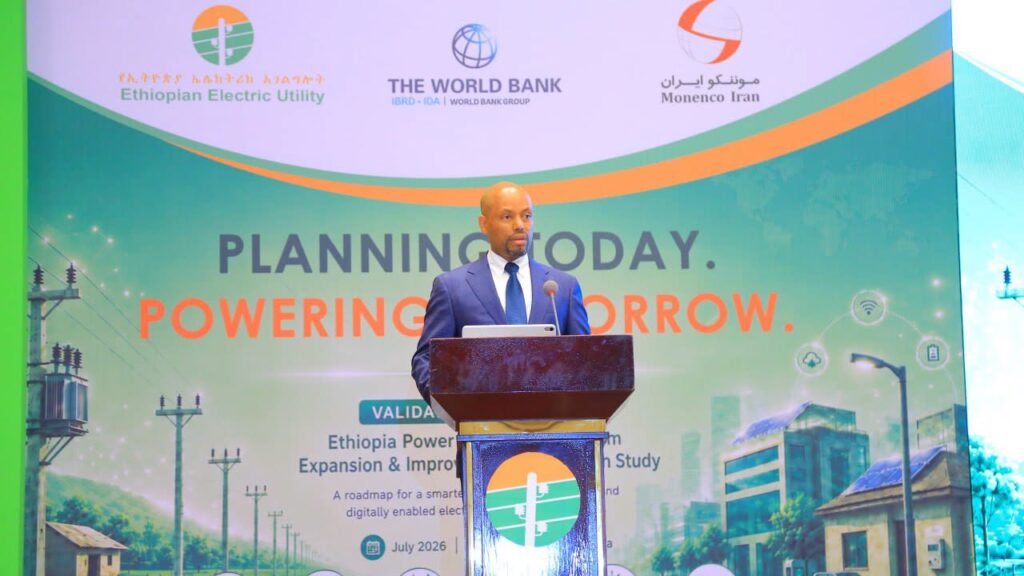
Speaking at the launch ceremony, EEU Chief Executive Officer Getu Geremu described the master plan as a landmark initiative that will transform Ethiopia’s electricity distribution system through modernization, digitalization and improved operational efficiency.
He said strengthening the distribution network is critical to supporting Ethiopia’s industrialization agenda, accelerating economic growth and improving the quality and reliability of electricity services for households and businesses.
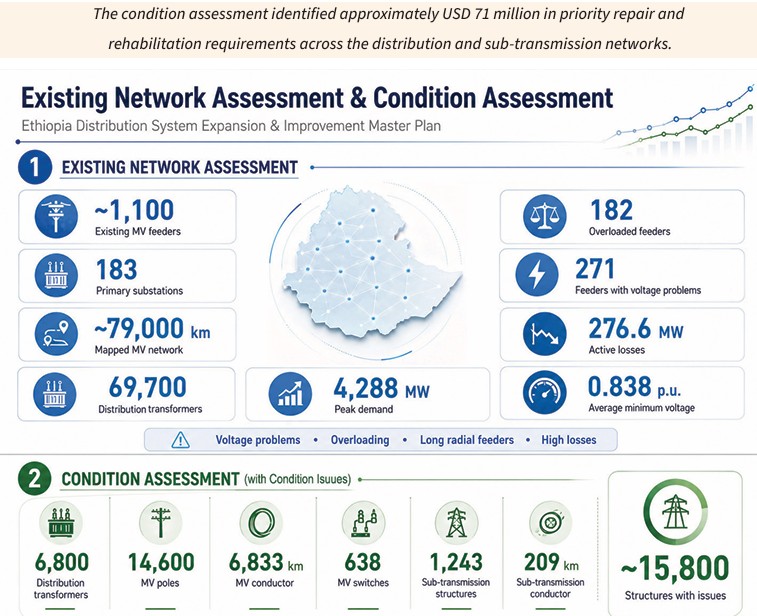
The master plan was developed based on a comprehensive assessment of the existing distribution system, which identified widespread technical constraints despite the network currently serving approximately 4,288 MW of peak demand.
The assessment covered around 1,100 medium-voltage feeders, 183 primary substations and nearly 79,000 kilometers of mapped medium-voltage distribution lines using GIS data, operational records, field inspections and power-system simulation models.
The analysis identified 271 feeders with unacceptable voltage levels and 182 feeders experiencing thermal overloading. Other major challenges include long radial feeders, aging and undersized conductors, overloaded transformers, limited switching facilities, insufficient load-transfer capability and high technical losses.
To address these challenges, EEU has prepared the four-year rehabilitation and expansion program requiring USD 1.33 billion in investment. The program includes new medium-voltage lines, rehabilitation and reconductoring of existing networks, transformer upgrades and additional capacity expansion. The number of medium-voltage feeders is expected to increase from about 1,100 to more than 1,400.
According to the master plan, the short-term investment program is expected to eliminate currently identified voltage and equipment-overloading problems while preparing the network for future electricity demand growth.
Although peak demand is projected to increase by 46 percent to approximately 6,243 MW, the upgrades are expected to improve average minimum network voltage from 0.838 per unit to 0.925 per unit and reduce active power losses by about 38 percent, from 276.6 MW to 171.2 MW.SECO