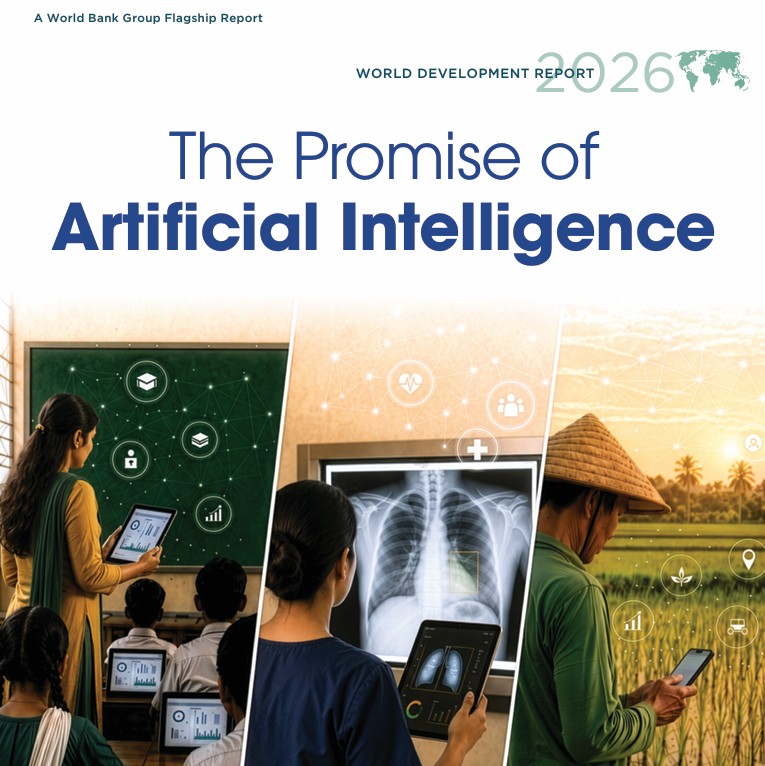
Artificial intelligence could give developing countries a rare chance to accelerate decades of economic and social progress—if they move quickly to build the foundations needed to use the technology effectively, according to the World Bank’s latest World Development Report 2026.
Released on Tuesday, the report argues that AI has the potential to help developing economies achieve in just ten years what might otherwise take a century. At a time when many of these countries are facing their weakest average economic growth in three decades, the technology could provide a much-needed boost to productivity, public services, and long-term development.
Rather than replacing workers, AI is expected to make them more productive. The World Bank estimates that only 4.5 percent of jobs in low- and middle-income countries face a significant risk of automation from generative AI, compared with 14.2 percent in high-income economies. Meanwhile, about 16.2 percent of jobs in developing countries could see meaningful productivity gains from AI—almost matching the 18.7 percent projected for wealthier nations.
“AI has thrown developing economies a lifeline, and they should seize it,” said Indermit Gill, the World Bank Group’s Senior Vice President and Chief Economist.
Gill said developing countries do not need to build expensive AI models or massive data centers to benefit from the technology. Instead, they can make significant progress by adapting affordable, smaller AI tools to local needs. Such applications could improve healthcare, education, agriculture, and public services, making quality services accessible to millions more people.
The report notes that AI is already finding practical uses across developing economies. Businesses are using it to analyze information and improve productivity, while governments are beginning to apply it to areas such as tax administration, disaster response, education, and social protection. Doctors can use AI to support medical diagnoses, farmers can make better decisions about crop management, and public agencies can deliver services more efficiently despite limited resources.
Still, the World Bank warns that the opportunity is far from guaranteed.
Many developing countries continue to face major obstacles, including unreliable electricity, limited internet access, shortages of digital skills, and weak institutional capacity. The report cautions that if these gaps are not addressed, AI could deepen inequality, widen the divide between rich and poor countries, concentrate market power in a handful of companies, and undermine public trust through concerns over privacy, bias, and accountability.
To avoid those risks, the World Bank recommends a gradual approach. Countries should first adopt AI tools that are already available, then adapt them to local conditions, and only later consider investing in frontier AI development after building the necessary infrastructure and expertise.
“The window to get this right is narrow,” said Gaurav Nayyar, who led the report. He said countries that invest today in electricity, internet connectivity, education, and stronger institutions will be far better placed to use AI to improve people’s lives and support economic growth.