
Ethiopia has signed 33 business-to-business (B2B) agreements worth more than $340 million with Chinese importers, strengthening efforts to expand exports to China as the country seeks to diversify its export basket and reduce its reliance on a handful of major commodities.
The agreements were signed during the “Export to China” forum organized by the Ministry of Trade and Regional Integration in collaboration with the Chinese Embassy in Ethiopia. The forum brought together Ethiopian exporters, Chinese buyers and senior officials from both countries to explore opportunities for expanding market access for Ethiopian products.

Trade and Regional Integration Minister Kassahun Gofe (PhD) said the initiative was intended to translate Ethiopia and China’s “sustainable and comprehensive strategic partnership” into stronger trade and economic relations.
He said the forum was part of the ministry’s efforts to promote Ethiopian products internationally and increase their presence in the Chinese market. The government has also undertaken promotional activities to encourage Chinese buyers to source more agricultural and industrial products from Ethiopia.
According to Kassahun, the 33 agreements cover products including coffee, sesame, soybeans, textiles and mineral products and are valued at more than $340 million. He said the deals could contribute to Ethiopia’s foreign-exchange earnings by increasing exports to China, one of the world’s largest consumer markets.
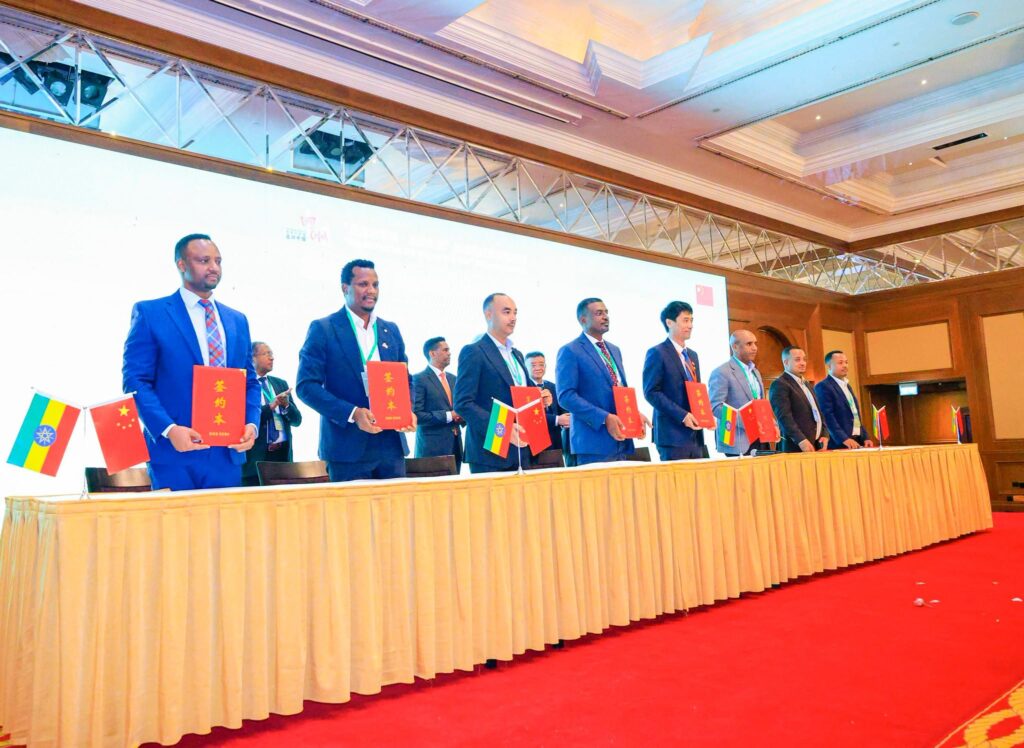
Chang Hui, Deputy Director-General of the Department of Foreign Trade at China’s Ministry of Commerce, said China remains committed to strengthening bilateral trade and economic cooperation with Ethiopia.
He said Beijing would work to expand market opportunities for Ethiopian products and deepen trade relations, while Chinese importers are prepared to increase purchases of quality Ethiopian commodities and establish sustainable, long-term relationships with Ethiopian exporters.
The agreements come at a time when Ethiopia is recording strong overall export growth but facing persistent challenges in diversifying the sources of that growth.
Ethiopia generated a record $11.2 billion in export earnings during the 2025/26 budget year, nearly 20 percent above the government’s target and 35 percent higher than the preceding year. However, gold and coffee accounted for nearly 80 percent of total export earnings, highlighting the country’s continued dependence on a relatively narrow export base.

Gold exports reached about $5.6 billion, while coffee generated $3.1 billion. By comparison, exports of oilseeds and pulses increased in volume but generated less foreign currency. Combined shipments of the two commodities rose 4.83 percent to 554,837 metric tons, while earnings fell 6.16 percent to $571.4 million from $609 million a year earlier.
The contrasting performance has raised concerns among exporters and sector experts that higher export volumes are not automatically translating into stronger foreign-exchange earnings. Lower international commodity prices, particularly for sesame, were cited as one factor behind the decline.
The Chinese agreements therefore come at a critical point for Ethiopia’s export strategy. Expanding access to China could provide exporters with a larger market for agricultural, manufactured and mineral products, while creating opportunities to broaden the country’s sources of foreign-currency earnings.
Exporters, however, say stronger market access needs to be accompanied by measures that increase production, improve quality and enhance competitiveness. They have called for additional incentives, including financing mechanisms linked to export performance and foreign-currency earnings.
The government has also recently increased the share of export earnings that commodity exporters can retain in foreign currency to 70 percent from 50 percent, with a further increase expected. Exporters welcomed the move but said additional measures are needed to address production, financing and market-related constraints.
The latest China deals also underline the importance of a coordinated national export strategy. Export responsibilities are currently divided among several government institutions, with different ministries overseeing commodities and sectors including coffee, oilseeds, minerals, manufacturing and electricity.
Experts argue that the fragmented structure makes it harder to coordinate production, financing, logistics, market access and export promotion.
Ethiopia has set an export earnings target of $13.4 billion for the 2026/27 budget year, almost 20 percent above last year’s record. The challenge will be to achieve that target while ensuring that growth comes from a broader range of competitive products and markets.
The $340 million agreements with Chinese buyers offer an immediate opportunity in that effort, but their longer-term impact will depend on Ethiopia’s ability to convert the contracts into sustained shipments, strengthen domestic production and build a more diversified export base.SECO