-Credit repayment continues as EEP seeks fresh financing
Ethiopian Electric Power (EEP) is in talks with an Italian financier to secure about €400 million to accelerate construction of the long-delayed Koysha Hydropower Project, as the government seeks to close a financing gap that has slowed implementation of the 1,800-megawatt project.
EEP Chief Executive Officer Ashebir Balcha said the government had previously secured approval to pursue commercial financing for Koysha under the country’s ongoing macroeconomic reform program, but efforts to mobilize the loan had not yielded results over the past two years.
The financing outlook has now improved, with an Italian financier agreeing in principle to provide about €400 million of the €500 million EEP currently estimates is required to advance the project. EEP plans to mobilize the remaining €100 million from its own resources.
“The financier has agreed to provide the major share of the financing we need to complete the project,” Ashebir said.
According to Demere Assefa, Deputy CEO for Corporate Finance and Resource Administration at EEP, the financing is being arranged with the involvement of SACE (Servizi Assicurativi del Commercio Estero), Italy’s export credit agency.
Demere told Et-Business View that SACE has given the green light for EEP to raise the required financing, with the current funding requirement estimated at about €500 million, significantly below earlier estimates of nearly $1 billion.
The negotiations have taken time because of detailed discussions over several financing conditions, particularly the interest rate and other contractual clauses, Demere said.
The government had initially estimated that Koysha would require about $950 million in additional financing when the macroeconomic reform program was launched two years ago. Since then, however, EEP has invested substantial resources in the project, settled outstanding obligations and advanced construction, reducing the remaining financing requirement.
“We have settled several outstanding payments and are now financing the project with our own foreign-currency resources,” Demere said.
EEP has also increased its foreign-currency earnings through electricity exports to neighboring countries and through electricity supplied to data-mining companies operating around Addis Ababa, according to the deputy CEO.
Repayment begins even as Koysha remains unfinished
While EEP is seeking new financing to complete Koysha, the utility has already begun servicing the debt that was used to finance the project in its earlier stages.
Debere said EEP paid €94 million to SACE during the budget year that ended on July 7 toward repayment of the credit secured for the Koysha project.
“We will continue paying to settle the credit,” he said.
The repayment obligation dates back to financing secured before Ethiopia imposed restrictions on new commercial external borrowing. Available information indicates that the project originally obtained about €340 million in loans from three banks, with the financing backed by SACE.
The debt was secured roughly a decade ago to support implementation of the project. However, Ethiopia’s decision to suspend new commercial external borrowing following the country’s deterioration into a high risk of debt distress in 2017 significantly constrained further financing options.
The government subsequently refrained from taking new commercial external loans, including for ongoing projects.
That policy began to change with the launch of Ethiopia’s macroeconomic reform program on July 29, 2024, supported by the International Monetary Fund and World Bank. Although the reform program continued to prioritize debt sustainability and restricted access to new commercial borrowing, Koysha was identified as an exception that could pursue external commercial financing.
The potential Italian financing would therefore represent a significant development for both Koysha and Ethiopia’s broader efforts to gradually restore access to external commercial capital.
Koysha reaches 77% completion
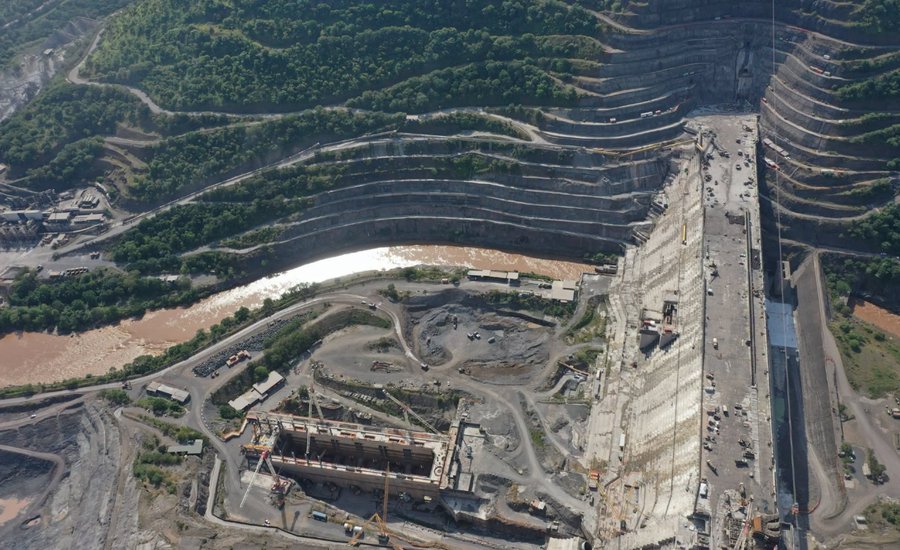
Located on the Omo River in southwestern Ethiopia, the Koysha Hydropower Project was initially estimated to cost about €3 billion. Construction is being carried out mainly by Italian construction company Webuild.
EEP said construction had reached 77% completion by the end of the 2025/26 budget year.
Under the revised implementation schedule, EEP expects to complete the project’s 121-metre-high dam by mid-2027. The full project is targeted for completion in 2029, while some generating units could begin producing electricity as early as 2028.
Once fully operational, Koysha will have an installed capacity of 1,800 MW, making it one of Ethiopia’s largest hydropower projects and a major addition to the country’s electricity-generation capacity.
The project was originally expected to be completed within seven years. Financing constraints and other implementation challenges, however, have taken at least ten years so far.
The latest financing talks are consequently being closely watched as EEP seeks to maintain the revised construction timetable while continuing to service the debt already incurred for the project.
If secured, the proposed €400 million Italian financing would provide EEP with the bulk of the remaining external funding required to move Koysha toward completion, while also marking one of the country’s most significant attempts to mobilize commercial external financing since the launch of its macroeconomic reform program.SECO