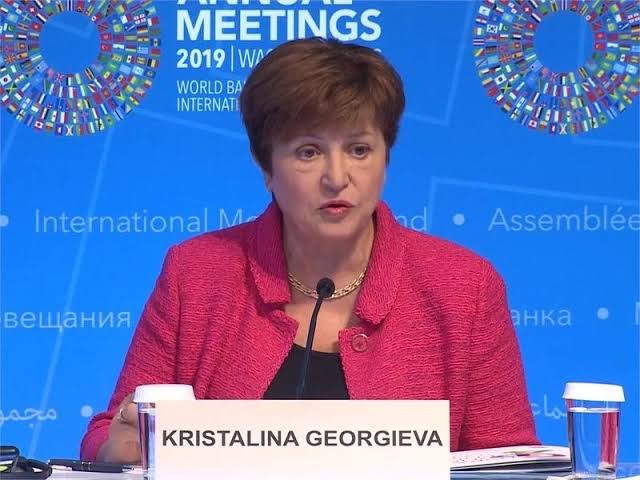
International Monetary Fund (IMF) Managing Director Kristalina Georgieva has called for stronger collective action to address mounting debt challenges facing developing and low-income countries, warning that high refinancing needs, rising debt-service costs and declining external financing are squeezing governments’ ability to fund critical development priorities.
In her statement to G20 Finance Ministers and Central Bank Governors, Georgieva said the global sovereign debt landscape has improved gradually in recent years, supported by domestic policy efforts and international cooperation, but stressed that progress remains uneven.
She identified rising global interest rates as a particular concern, noting that higher yields in advanced economies are lifting borrowing costs across global markets. In some emerging markets, she said, this has more than offset hard-won reductions in sovereign risk spreads.
“Helping countries create fiscal space to support growth-enhancing spending is even more pressing in the current conjuncture,” Georgieva said.
According to the IMF chief, high refinancing requirements and increasing debt-service costs are limiting many developing economies’ capacity to invest in infrastructure, health and education. Such constraints could weaken economic growth and further undermine debt sustainability.
These pressures have been compounded by a sharp decline in net external financing, including cuts in official development assistance and reduced new inflows from non-Paris Club creditors.
Georgieva outlined three priorities for tackling the challenges.
First, she called for decisive action in countries where debt is unsustainable, supported by further improvements in restructuring processes. She pointed to progress under the G20 Common Framework and the Global Sovereign Debt Roundtable, while stressing the need for solutions for countries outside the Common Framework.
Second, she urged faster implementation of the IMF-World Bank Three-Pillar Approach for countries with sustainable debt and strong growth potential. The approach includes support for reforms, domestic resource mobilization and measures to encourage private-sector financing at lower costs.
Third, Georgieva stressed that sound economic fundamentals remain essential, including stronger debt transparency, debt-management capacity and debtor-investor relations.
She said collective support from the G20, bilateral creditors, international financial institutions and private investors will be critical to helping vulnerable countries restore fiscal space, finance investment and maintain debt sustainability.SECO