-EDIF Premium Income Set to Surge
The Ethiopian Deposit Insurance Fund (EDIF) expects its deposit insurance premium collections to surge in the current fiscal year as deposits held by banks and microfinance institutions (MFIs) continue to expand rapidly, while the Fund is developing a target-fund model to determine how much it needs to accumulate and over what period.
EDIF officials said the growing deposit base is expected to significantly increase premium collections, but warned that limited investment options remain a major challenge to generating sufficient returns from the Fund’s resources.
The Fund, established in March 2023 to protect depositors and contribute to the stability of Ethiopia’s financial system, currently relies predominantly on Treasury bills issued by the National Bank of Ethiopia (NBE) on behalf of the Ministry of Finance to invest premiums collected from member banks and MFIs.
During the 2025/26 fiscal year, EDIF invested about 24.4 billion birr, or more than 91 percent of its investment portfolio, in Treasury bills, while about 2.4 billion birr, or 8.8 percent, was invested in Mudarabah Term Deposits (MTDs). The investments generated about 2.5 billion birr in income, helping raise the Fund’s reserve balance to 27.43 billion birr.
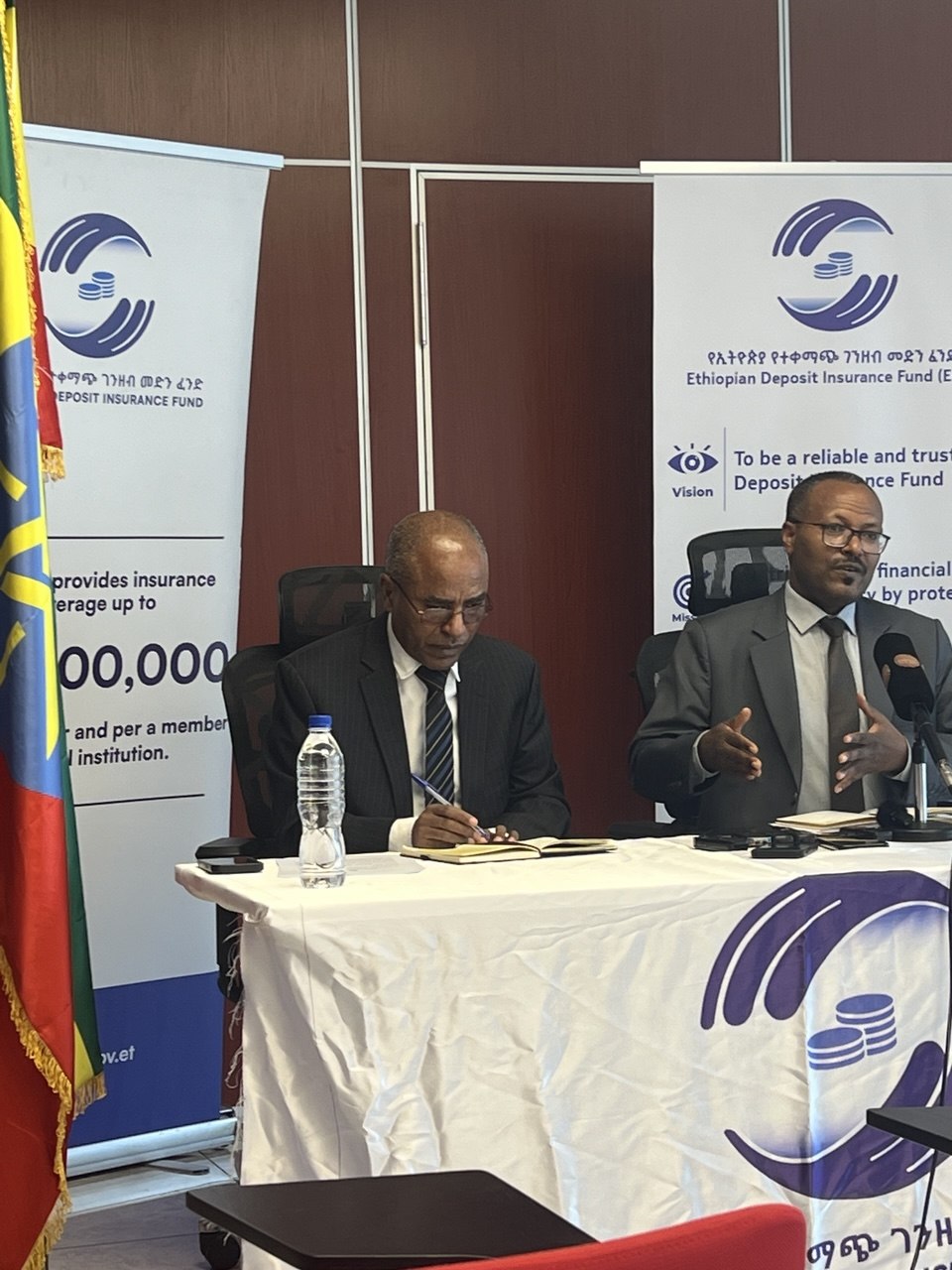
Merga Wakweya, Operations Directorate Director at EDIF, said the decline in Treasury bill yields has become a significant challenge for the Fund.
“In the past, the interest rate had reached 18 percent, which made us delighted, but the interest rate has eroded to up to 7 percent,” Merga told EtBusinessView.
He said the Fund faces limited alternatives for investing its resources without taking on excessive risk.
“Other countries’ similar funds invest their resources in the same areas, but maybe they have long-term investments, such as Treasury bonds,” he said.
Ethiopia currently does not have an established Treasury bond market, although the government is expected to introduce longer-term government securities.
Merga said EDIF would consider investing in Treasury bonds only after a functioning secondary market is established, allowing the Fund to liquidate its holdings quickly if it needs cash to compensate depositors following the failure of a member financial institution.
“The Treasury bond is very profitable since it is a long-term investment, but we have to make sure that it shall be easily liquid if the Fund needs cash,” he said.
EDIF also expects the planned introduction of a Sukuk market in Ethiopia to provide another potential investment avenue, particularly for resources generated from interest-free deposits.
The Fund currently places premiums collected from interest-free banking deposits in Mudarabah Term Deposits, an investment structure that carries greater risk than Treasury bills.
EDIF officials said the Fund’s investment priorities are guided by three key principles: safety, liquidity and return. Safety and liquidity take precedence because the Fund must be able to access its resources when a member financial institution fails.
Target-fund model

EDIF is now developing a target-fund model that will reassess the amount of resources the Fund needs to accumulate relative to the risks facing member institutions.
“We will do a target fund model that would review the former estimation. The target fund model will allow accounting for the risk that would actually be seen in MFIs and banks,” Merga said.
The model will also help determine whether the existing deposit insurance premium rate remains adequate.
The current annual premium is set at 0.3 percent of insured deposits. Merga said there is currently no plan to increase the rate, which was established by the government about five years ago.
However, he said international experience suggests that deposit insurance premium rates are generally reviewed periodically.
“The experience of other countries indicated that the premium rate shall be reviewed every five years, but it would actually happen for us now,” he said.
The need to reassess the premium comes as deposits across Ethiopia’s banking sector have expanded sharply. Total deposits reached about 5 trillion birr at the end of the 2025/26 fiscal year, reflecting continued strong deposit mobilization by commercial banks.
EDIF currently has 31 banks and 66 MFIs as member institutions.
Premium collections accelerate
EDIF’s premium collections have increased rapidly in line with deposit growth.
The Fund collected 9.35 billion birr in premiums during the 2025/26 fiscal year, according to EDIF CEO Desalegn Ambaw (PhD), representing a 31.14 percent increase from the previous year.
Private banks contributed 4.8 billion birr, or 51.23 percent, of the total. The state-owned Commercial Bank of Ethiopia contributed 4.45 billion birr, or 47.60 percent, while MFIs contributed 109.3 million birr, equivalent to 1.17 percent.
Of the total premiums collected, 8.40 billion birr, or 89.8 percent, came from conventional deposits, while 951.96 million birr, or 10.2 percent, came from interest-free deposits.
Since its official launch three years ago, EDIF has collected a cumulative 23.42 billion birr in premiums from member financial institutions.
The Fund expects collections to rise further in the current fiscal year.
EDIF had collected 7.1 billion birr in premiums in the first of the previous two fiscal years and 9.3 billion birr in the following year, before reaching 9.35 billion birr in 2025/26. Its premium collections are projected to rise significantly in the current fiscal year as the deposit base expands.
Reserve projected to reach 45.6 billion birr
EDIF has also expanded its investment portfolio considerably.
Desalegn said the Fund’s investment portfolio reached 26.81 billion birr at the end of the 2025/26 fiscal year, up 76.73 percent from 15.17 billion birr a year earlier.
“As a result, the Fund’s total reserve balance currently stands at 27.43 billion birr, indicating that it is steadily building up the financial capacity to pay the necessary compensation in the event of a member financial institution’s failure,” Desalegn said.
For the current fiscal year, EDIF projects total revenue of 18.14 billion birr, including 12.95 billion birr in regular annual premiums from member financial institutions, 1.5 billion birr in interest-free annual premiums and 3.67 billion birr in investment income.
The Fund expects its total reserve balance to reach 45.57 billion birr by the end of the fiscal year, representing an increase of about 66.7 percent from the previous year’s 27.43 billion birr.
The projected increase underscores the rapid expansion of EDIF’s financial capacity, but also increases the importance of finding investment instruments capable of preserving the Fund’s liquidity while generating adequate returns.
Protection limit under review
EDIF’s primary mandate is to protect small depositors in the event that a member financial institution fails.
The Fund currently guarantees deposits of up to 100,000 birr per depositor. Officials said the coverage limit should be periodically reviewed to reflect changes in deposit levels, inflation and international practices.
“In principle, we believe this amount should be periodically revised to align with international best practices,” EDIF officials said.
The Fund has also completed the review and preparation of policies and guidelines governing its operations and administrative activities during the concluded fiscal year.
Established in March 2023, EDIF is mandated to strengthen depositor confidence and contribute to the stability and soundness of Ethiopia’s financial system. Its latest assessment indicates that the current 100,000-birr protection limit covers about 98 percent of depositors, up from an earlier estimate of 97 percent.SECO