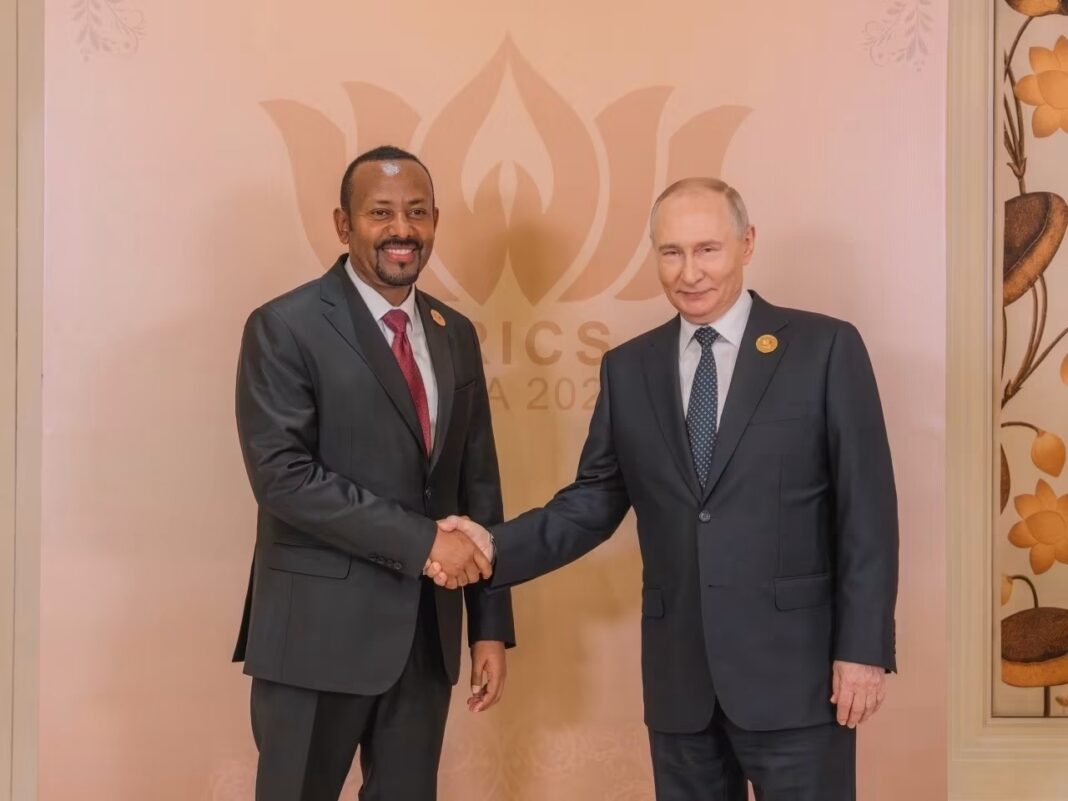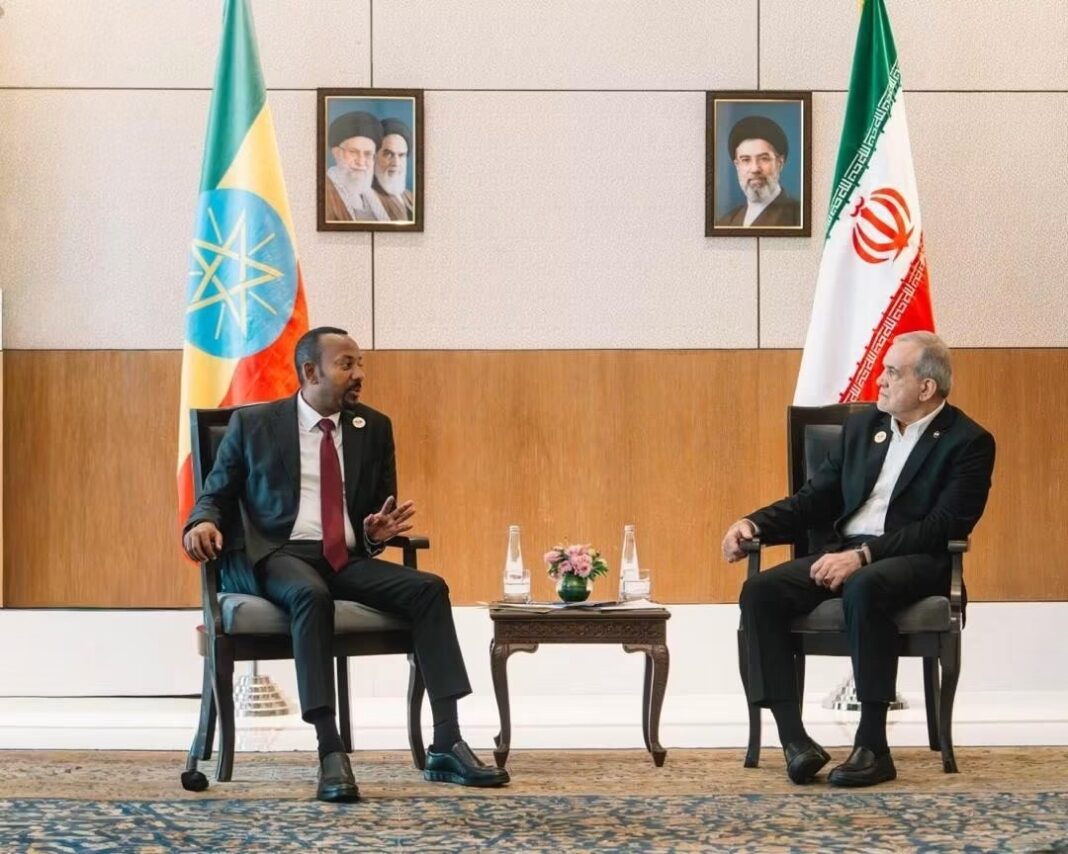
Ethiopian Prime Minister Abiy Ahmed and Iranian President Masoud Pezeshkian have discussed the latest security developments in the Red Sea, as a major advance by Yemen’s Houthi movement has intensified concerns over the strategic maritime corridor.
The two leaders met on the sidelines of the BRICS Summit in New Delhi, India, with the Red Sea situation emerging as an important regional issue. According to a social media post by Prime Minister Abiy, the leaders underlined the relevance of dialogue and the need to realize stability in the region.
The meeting comes at a particularly sensitive moment for the Red Sea. Yemen’s Iran-aligned Houthi movement has made rapid territorial gains along the country’s Red Sea coast, including the strategic port city of Mocha, while reports indicate that the group has also expanded its control around the Bab al-Mandeb Strait.
The development has heightened concerns over maritime security in one of the world’s key shipping corridors linking the Red Sea with the Gulf of Aden and the wider Indian Ocean. Any sustained disruption could have significant implications for countries that depend heavily on the route for trade.
The issue carries particular importance for Ethiopia, a landlocked country that relies heavily on Djibouti as its principal maritime outlet. Increased security risks around Bab al-Mandeb could raise shipping costs and complicate access to international markets.
Iran’s role also makes the Abiy-Pezeshkian meeting significant. Tehran has maintained close ties with the Houthi movement, while Iran has long regarded the Red Sea and the Horn of Africa as strategically important. The latest Houthi gains have therefore added a new dimension to Ethiopia’s engagement with Tehran.
Although Ethiopia and Iran have maintained diplomatic relations for more than seven decades, high-level political engagement between the two countries has historically been limited. However, bilateral contacts have increased in recent years, particularly since both countries joined BRICS. Iranian Parliament Speaker Mohammad Bagher Ghalibaf visited Addis Ababa in January 2025, while Ethiopian House Speaker Tagesse Chafo later visited Tehran. Ethiopian and Iranian officials have also discussed expanding political, economic and maritime cooperation.
The latest meeting between Abiy and Pezeshkian is not their first. The two leaders also met on the sidelines of the BRICS Summit in Kazan in October 2024, where Abiy said Ethiopia was ready to support efforts to de-escalate tensions in the Middle East.
The renewed focus on the Red Sea comes as Ethiopia continues to seek reliable and diversified access to the sea, an issue that has become increasingly prominent in its regional foreign policy since the loss of its coastline following Eritrea’s independence in the early 1990s.
With the Bab al-Mandeb now facing heightened security risks, Ethiopia’s interest in developments across the Red Sea is no longer only a geopolitical concern but also an increasingly important economic and trade issue.SECO