- Key Figures
- –US$7.14 billion — Ethiopia’s estimated remittance inflows in 2025, ranking it fourth in Africa.
- –824% — Ethiopia’s remittance growth since 2016.
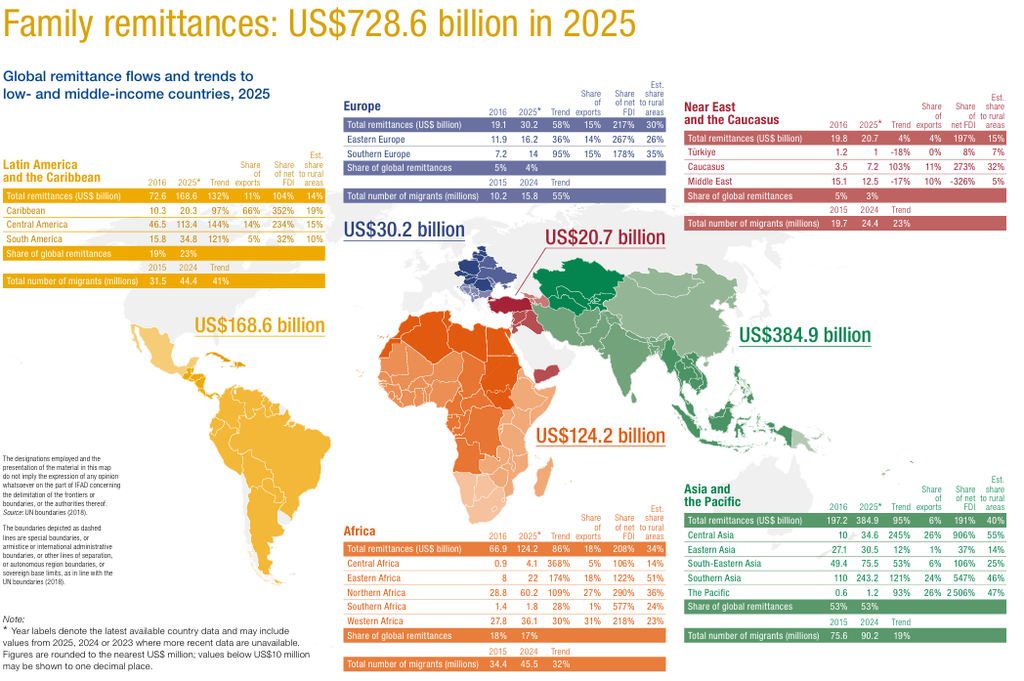
- -$124.2 billion — Africa’s total remittance inflows in 2025, up 86% over the past decade.
- –$728.6 billion — Global remittance flows in 2025, nearly double the 2016 level.
- -4.59% — Average cost of digital remittance services in 2025, compared with 7.30% for non-digital services.
Ethiopia has emerged as Africa’s fourth-largest recipient of remittances, receiving an estimated US$7.14 billion in 2025, as money sent home by migrants continues to become an increasingly important source of foreign exchange and household income.
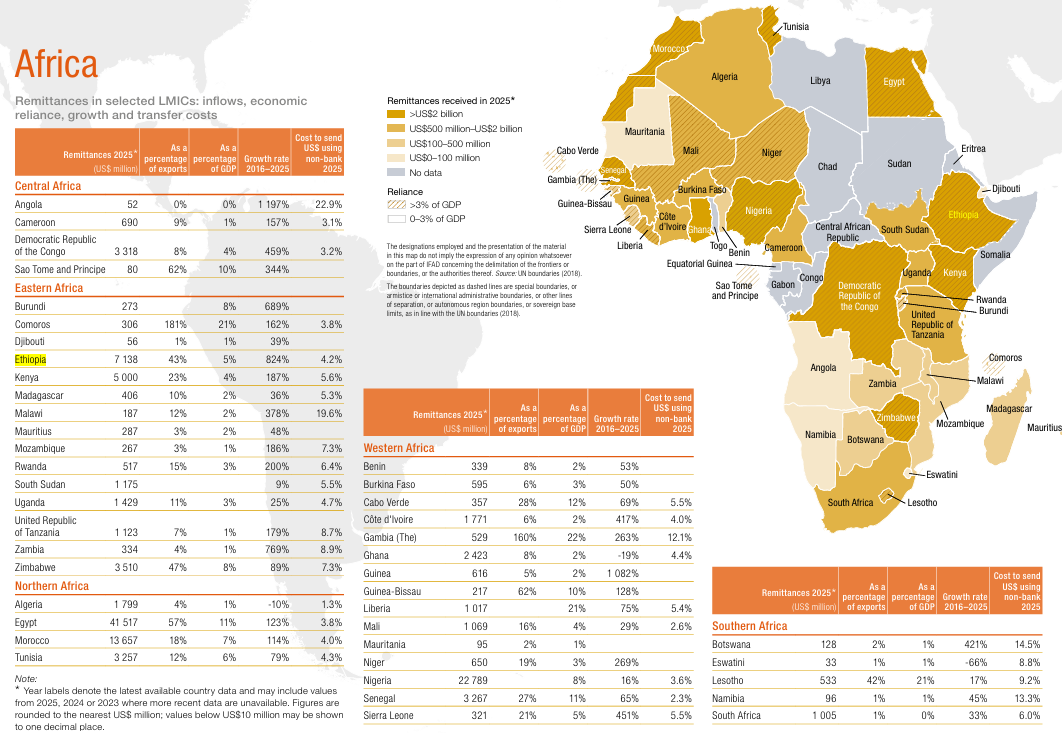
The figure places Ethiopia among the continent’s five biggest remittance markets, alongside Egypt, Nigeria, Morocco and Kenya, according to the International Fund for Agricultural Development’s (IFAD) Sending Money Home 2026 report.
The report estimates Ethiopia’s 2025 remittance inflows at US$7.138 billion, equivalent to 43 percent of the country’s exports and around 5 percent of GDP. It also records an 824 percent increase in Ethiopia’s remittance inflows compared with 2016.
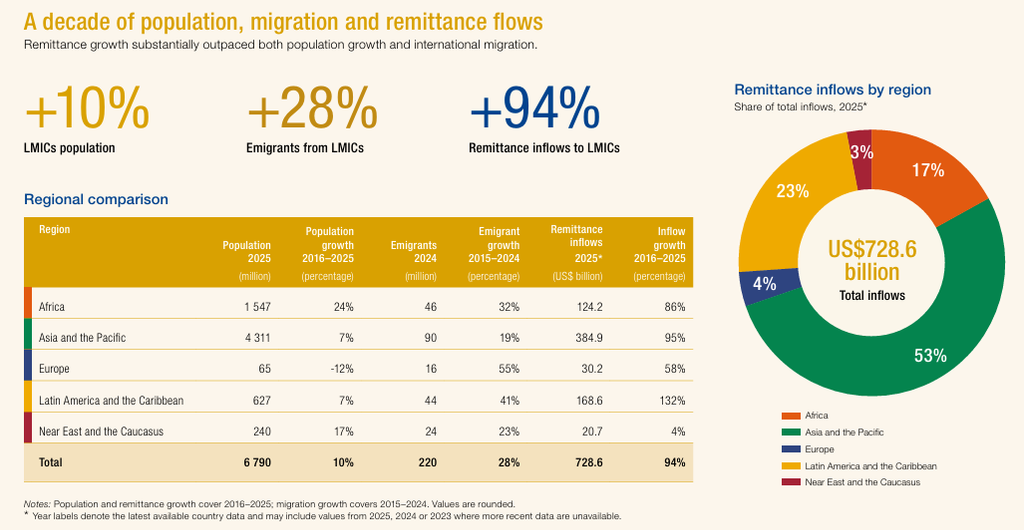
Ethiopia’s entry into the continent’s top five marks a significant shift in Africa’s remittance landscape. IFAD estimates that Africa received US$124.2 billion in remittances in 2025, up 86 percent from 2016. Egypt led the continent with US$41.5 billion, followed by Nigeria at US$22.8 billion and Morocco at US$13.7 billion, while Kenya received US$5 billion. Together, the five leading markets accounted for about 73 percent of Africa’s total remittance inflows.
The report highlights the growing importance of remittances for Ethiopia within the broader Eastern African market. Remittances to Eastern Africa increased from US$8 billion in 2016 to US$22 billion in 2025, representing a 174 percent increase. The region also had the highest estimated rural share of remittances in Africa, at 51 percent.
For Ethiopia, the scale of remittances is particularly significant given the country’s foreign-exchange constraints. The report’s estimate indicates that remittances were equivalent to nearly half of the value of Ethiopia’s exports in 2025, underlining their importance as a source of foreign currency.
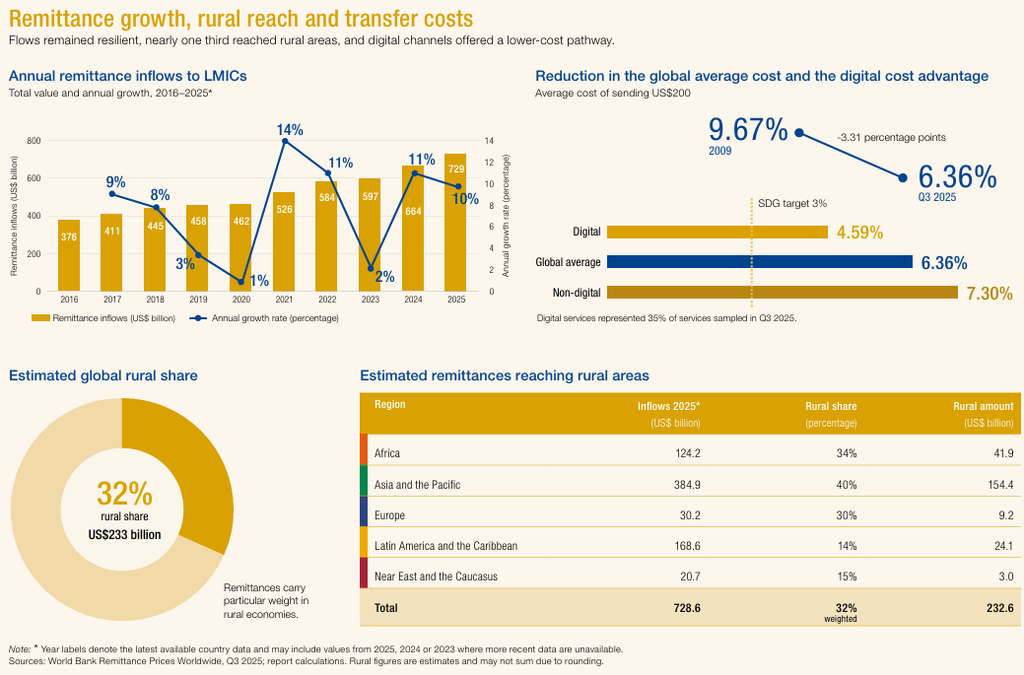
However, the cost of sending money to the region remains a major challenge. The average non-bank cost of sending US$200 to Eastern Africa declined from 9.7 percent in 2016 to 7.2 percent in 2025, but remains well above the global Sustainable Development Goal target of below 3 percent. The report puts the non-bank cost for Ethiopia at 4.2 percent in 2025.
The global remittance market is also rapidly shifting toward digital channels. More than half of remittances to low- and middle-income countries were initiated digitally in 2025, while fully digital transfers averaged a cost of 4.6 percent, compared with 7.3 percent for non-digital services.
IFAD argues that the opportunity for countries such as Ethiopia goes beyond simply increasing remittance inflows. Greater financial inclusion can enable recipient families to use remittances for savings, insurance, enterprise and investment while maintaining their role in meeting immediate household needs.
The report also points to a wider opportunity through the diaspora. It estimates that diaspora communities globally hold around US$500 billion in annual savings, but says reliable and accessible investment opportunities in countries of origin remain limited.
Experts stated that for Ethiopia, the findings highlight the potential of remittances not only as a source of household support but also as an increasingly important component of the country’s foreign-exchange and financial-inclusion landscape.SECO