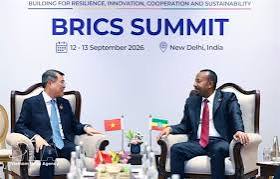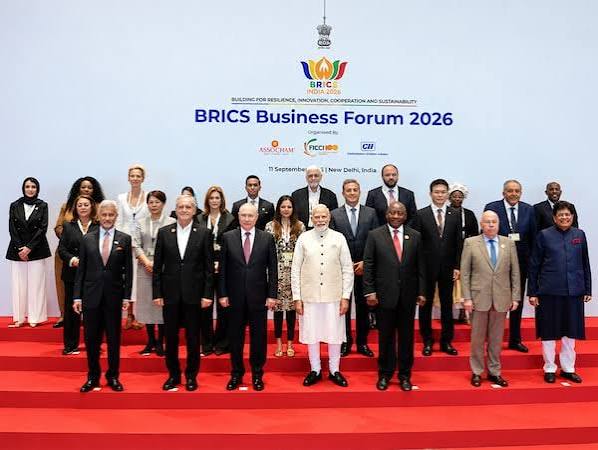
BRICS leaders have endorsed a broad economic agenda aimed at strengthening trade among member countries, expanding local-currency transactions and giving emerging economies a greater voice in global financial institutions, under the New Delhi Declaration adopted at the 18th BRICS Summit in New Delhi on September 12–13, 2026.
The 140-paragraph declaration condemns unilateral tariffs and non-tariff trade measures, warning that rising protectionism is disrupting global trade and supply chains. BRICS called for a stronger, rules-based multilateral trading system and reforms to the World Trade Organization (WTO).
A major economic focus is reducing dependence on the US dollar. The leaders backed greater use of BRICS members’ local currencies for trade settlements and investment, while instructing the BRICS Payment Task Force to continue work on interoperability between national payment and messaging systems. However, the declaration does not establish a common BRICS currency or a single bloc-wide payment system.
The declaration also gives a stronger mandate to the New Development Bank (NDB) to mobilize resources, diversify its funding base and expand lending in local currencies. The bank is encouraged to finance infrastructure and sustainable-development projects covering clean energy, transport, water and sanitation, social infrastructure and digital integration. BRICS also backed efforts to expand NDB membership.
BRICS leaders further supported the development of a new investment platform, while India’s proposal for a BRICS Risk Lab at GIFT City received backing. The bloc also endorsed measures to strengthen financial resilience, including multilateral guarantees intended to improve the creditworthiness of development projects.
On global financial governance, BRICS renewed calls for greater representation of emerging and developing economies in the IMF and World Bank, including reforms to quotas, voting rights and governance structures.
Energy security also featured prominently in the economic agenda. BRICS called for stable and diversified energy markets, resilient supply chains and stronger cross-border energy infrastructure. It recognized that fossil fuels will continue to play an important role in developing economies while advocating a “just, orderly, equitable and inclusive” energy transition and greater cooperation on critical minerals.
The declaration additionally highlights food security, agriculture, digital infrastructure, artificial intelligence, industrial cooperation and supply-chain resilience as areas for deeper BRICS cooperation.
For Ethiopia, a particularly relevant element is the declaration’s emphasis on expanding NDB financing, local-currency lending, infrastructure investment and greater access for emerging economies—areas that could become increasingly important as BRICS seeks to strengthen economic integration across the Global South.