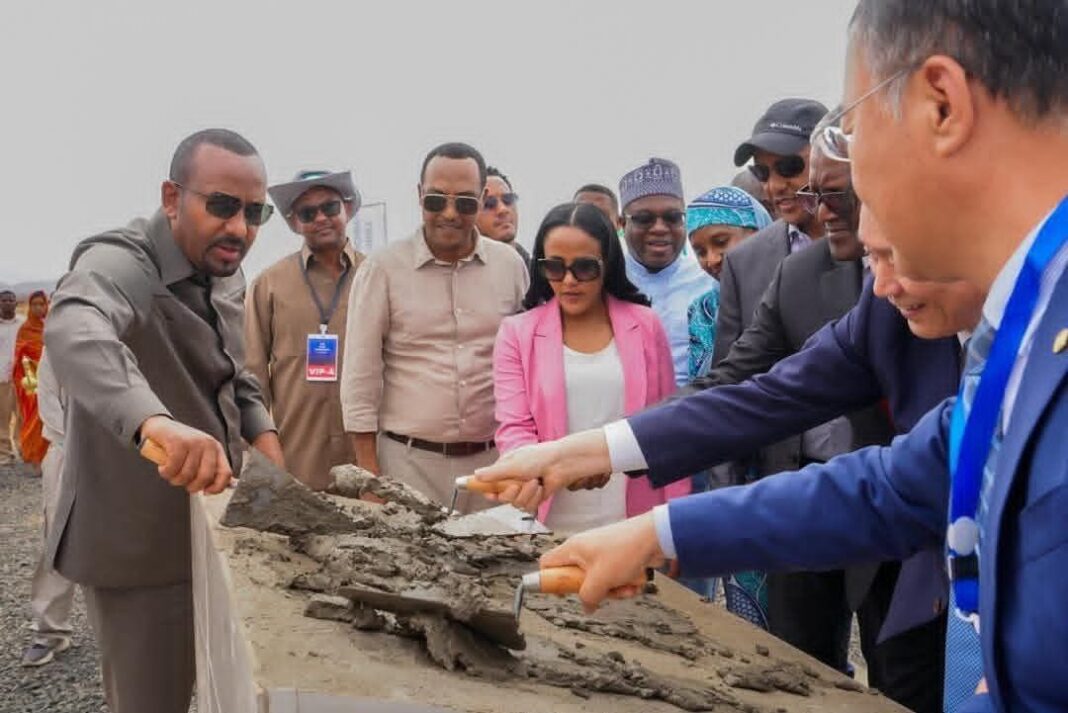
By staff reporter In a historic move, the Ethiopian government has inaugurated a suite of four major hydrocarbon projects with a combined investment of $6.4 billion.
The official ceremony was held in Calub, located in the Somali Region, marking a significant milestone in a pursuit that began nearly a century ago with initial exploration in the 1920s.
The centerpiece of this initiative is a new natural gas industrial complex in Calub, which will initially produce 200,000 cubic meters of refined natural gas per day. A second phase, launched concurrently, will expand this capacity to 600,000 cubic meters.
A History of Discovery and New Potential
The Calub and Hilala gas fields were first discovered by the American company Tenneco in 1972. Their potential was later confirmed in the 1980s by the Soviet Petroleum Exploration Expedition, which estimated reserves at four Trillion Cubic Feet (TCF).
More recently, in 2018, the Chinese GCL Group made a significant new discovery, appraising the recoverable gas reserves in the Calub field to be between 6 and 8 TCF.
The same company discovered oil in new exploration wells near the Hilala locality, approximately 1,200 km southeast of Addis Ababa. However, it was unable to develop the resource, which led to the revocation of its license.
The oil field is now estimated to contain 323 million barrels. After a previous license revocation, a new agreement was signed in April 2024, committing the company to develop the resource within 14 months.
Integrated Industrial Development The projects are designed for comprehensive industrial development. The natural gas will not only be processed for domestic use and export but will also fuel a 1,000 MW power plant.
Further integrating the sector, an oil refinery will be constructed at the Gode Industrial Park, 1,166 km south of Addis Ababa.
The refinery will be built in two phases over three years, with an initial capacity of one million metric tons per annum, scaling up to 2.5 million metric tons. Additionally, the government has signed an agreement with the Dangote Group to establish a fertilizer complex in Gode for the production of urea and ammonia.
This facility, expected to be completed in 40 months, will be supplied with natural gas via a 108 km pipeline from Calub, 1280km south east of Addis. With an annual production target of 3 million metric tons, the complex is poised to significantly reduce Ethiopia’s foreign currency expenditure on fertilizer imports.
Together, these four interconnected projects represent a transformative step for Ethiopia’s economy, unlocking long-held natural resources for energy, industry, and agricultural self-sufficiency. ©SECO