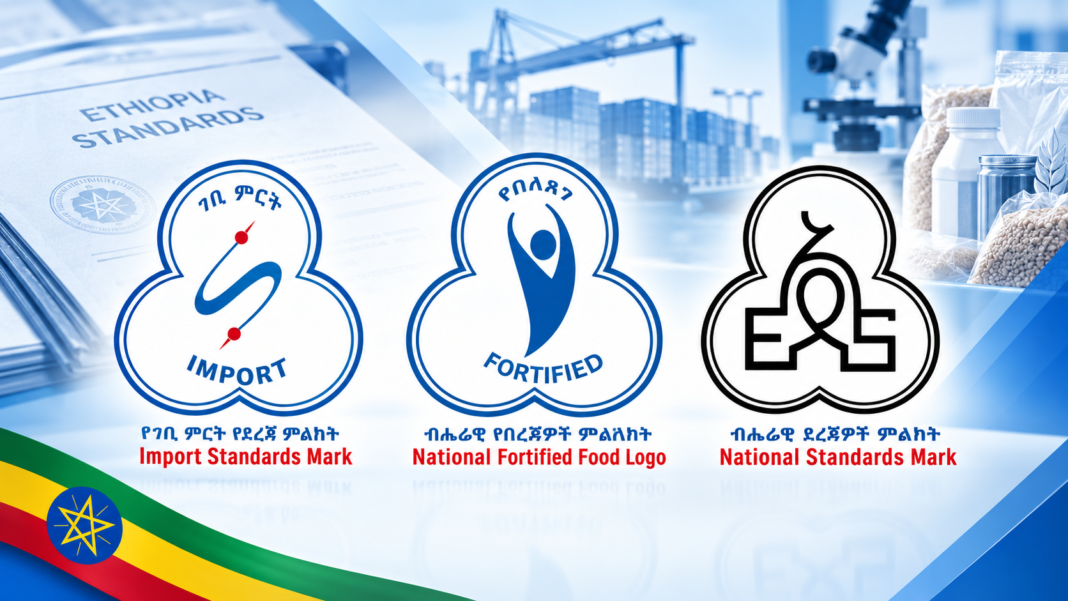
Draft Regulation Seeks to Replace 36-Year-Old Standards Mark Framework
The Institute of Ethiopian Standards (IES) is preparing to introduce a new standards mark fee system that could significantly increase charges paid by manufacturers, with industry players warning that the proposed change could eventually push up consumer prices.
The IES has drafted the ‘Ethiopian Standards Mark Administration Regulation’, which would replace the legal framework governing the standards mark system that dates back 36 years to Regulation No. 13/1990, issued during the Derg period.
The draft regulation has been under preparation for about a year and was recently presented to stakeholders, particularly manufacturers. However, sources familiar with the process told EtBusinessView that the regulation has not yet been approved by the Council of Ministers, which is responsible for issuing regulations.

The proposed fee structure has already triggered concerns among private-sector players. One source who discussed the draft with EtBusinessView said the proposed system would give the IES room to revise standards mark charges, potentially resulting in fees that are significantly higher than those applied in other countries.
Under the draft regulation obtained by EtBusinessView, the fee for the use of the Ethiopian Standards Mark would be calculated based on a company’s sales volume.
Industry representatives argue that the proposed fee would ultimately affect consumers rather than manufacturers, as companies are likely to treat the additional payment as part of their production costs and incorporate it into the prices of their products.
Sources said the IES has set a target of collecting 300 million birr from standards mark-related charges during the current fiscal year, compared with approximately 2 million birr collected in the previous fiscal year.
They said the significant increase in the targeted revenue has raised concerns over the potential cost implications of the proposed system.

“It shows how much money they are targeting to collect from the service, while it could affect the general public because it would contribute to inflation,” sources said.
A source in the manufacturing sector told EtBusinessView that manufacturers became aware of the proposed changes after the IES asked them to submit their annual sales figures and other information.
The source said manufacturers were concerned that the regulation could have been advanced without sufficient consultation with affected businesses.
Several business associations have reportedly communicated their concerns to relevant government institutions, including the Ministry of Finance, outlining what they consider to be the potential economic consequences of applying the proposed fee structure.
Experts familiar with conformity assessment told EtBusinessView that standards mark fees had previously been collected alongside annual testing, market surveillance and certification audits.
Although administration of the standards mark falls under the mandate of the standards institution, the collection of the related fees had previously been carried out by the Ethiopian Conformity Assessment Enterprise (ECAE) on its behalf, according to the experts.
They said the proposed system would centralize standards mark administration under the IES, a model they said is also used in other countries.
However, they expressed concern that calculating fees based on sales volume could result in substantially higher payments for manufacturers.
“If the payment is calculated based on sales volume, the amount could be very high,” one expert said, warning that manufacturers could pass the additional cost on to consumers through higher prices.
IES Says Existing Framework Is Outdated
The IES, in its explanation accompanying the draft regulation, argues that the existing legal framework is no longer adequate for Ethiopia’s current economic, technological and quality-infrastructure environment.
The document states that the use of an independent conformity mark in Ethiopia began under Regulation No. 13/1990, which established standards marks and related service fees.
However, the regulation was limited to products for which mandatory standards had been established at the time, according to the IES.
The institute argues that the framework failed to accommodate standards introduced subsequently as well as changes in Ethiopia’s economic and social development.
It also says the existing regulation is no longer compatible with the country’s current quality infrastructure framework.
The IES further points to powers granted to the former Ethiopian Standards Agency under Establishment Regulation No. 193/2010 and, more recently, under Proclamation No. 1343/2024.
Under the new proclamation, the institute is mandated to determine the design and content of the National Standards Mark and issue licenses for its use.
According to the draft, the absence of a comprehensive legal framework has constrained the effective administration of the standards mark system.
The institute says attempts to administer the mark through delegated authority because of institutional limitations also created challenges.
Among the problems identified by the IES are the limited scope of the old regulation, the failure to accommodate new standards and technological developments, and the difficulties associated with delegating standards mark administration to multiple conformity assessment bodies.
The institute argues that these challenges create a need for a centralized national standards mark administration system.
The draft also identifies the absence of different marks for different standards, difficulties in applying the existing mark to similar imported products, and the lack of provisions covering voluntary standards, imported products and products using fortification marks.
It further cites inadequate technological support for identifying and using the standards mark, as well as improper use of the mark and weak monitoring mechanisms.
IES Seeks Stronger Consumer Assurance
The proposed regulation is intended to establish a system under which the Ethiopian Standards Mark would provide consumers with assurance that products carrying the mark comply with applicable Ethiopian Standards.
The IES says the system would also increase market acceptance of compliant products and enhance the competitiveness and credibility of manufacturers.
Another objective is to establish a system that allows consumers to more easily identify both domestically manufactured and imported products that comply with Ethiopian Standards.
The draft also seeks to establish procedures for granting, renewing and revoking licenses to use the Ethiopian Standards Mark.
While the IES presents the regulation as a measure to modernize the country’s standards mark administration and strengthen consumer protection, manufacturers and conformity-assessment experts have raised concerns over the financial burden associated with the proposed fee structure.
The regulation remains a draft and will require approval by the Council of Ministers before it can take effect.SECO