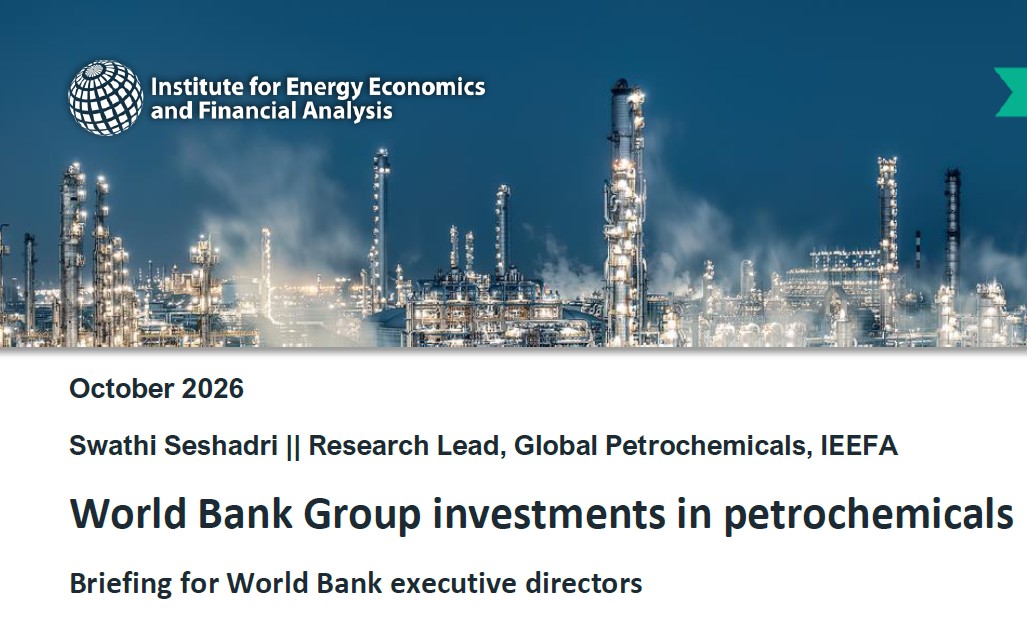
The World Bank Group has invested $6.6 billion in petrochemical and fertiliser projects, with its portfolio financing $7.49 in new production capacity for every $1 allocated to decarbonisation, according to a new analysis by the Institute for Energy Economics and Financial Analysis (IEEFA).
The findings, outlined in a briefing prepared for World Bank Group executive directors during the institution’s annual meeting in Bangkok, raise concerns about the alignment of development finance with climate commitments and the environmental risks associated with expanding fossil fuel-linked industries.
The World Bank Group accounts for 48 of the 93 projects tracked in a database compiled by IEEFA and the International Accountability Project (IAP). The projects represent 65.7% of the $10.04 billion in investments recorded across 16 multilateral development banks.
According to the briefing, 86.7% of the World Bank Group’s petrochemical portfolio, valued at $5.72 billion, supports new production capacity, while $763.9 million, or 11.6%, is directed towards decarbonisation and efficiency.
The analysis also questions the Group’s claim of achieving full Paris Agreement alignment at the project level, arguing that individual transactions may meet alignment requirements even when financing structures indirectly support fossil fuel-related activities.
The briefing highlights the proposed fourth production line at Indorama Eleme in Nigeria, for which the International Finance Corporation (IFC) published an early disclosure on July 27, 2026. The project, which includes a 65-kilometre gas pipeline, has been provisionally classified as Category A, the IFC’s highest environmental and social risk rating.
The expansion comes as a joint compliance investigation into the complex’s third production line remains open. The investigation concerns allegations of pollution affecting the Okulu River and the absence of a cumulative impact assessment.
The report further finds that $4.47 billion, or 67.7% of the World Bank Group’s tracked portfolio, flows through financial intermediaries, raising questions about transparency and the monitoring of environmental and social risks.
IEEFA has urged the World Bank Group to strengthen disclosure, introduce sector-specific safeguards and assess petrochemical investments more rigorously against its climate commitments.SECO