By EBV staff writer
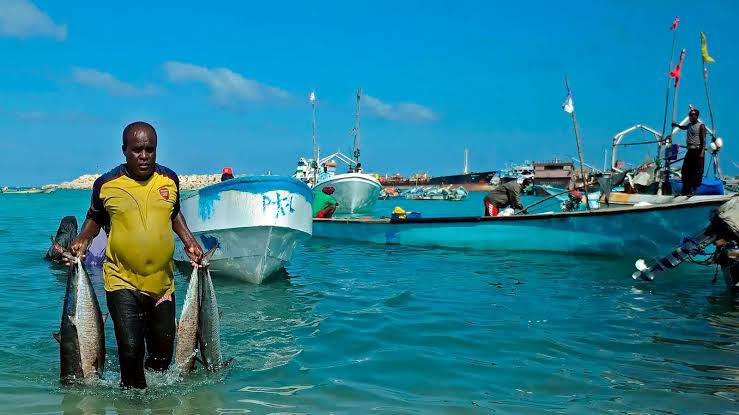
In a move signaling deeper economic integration in the Horn of Africa, Somalia has formally expressed its intent to significantly expand the export of marine products to neighboring Ethiopia. The proposition was the central focus of a high-level meeting held in the Somali capital on January 10, 2026.
Somali Minister of Fisheries and Blue Economy, Ahmed Hassan Aden, convened with Ethiopia’s Acting Ambassador to Somalia, Ketema Haile, to discuss frameworks for facilitating and streamlining bilateral trade in seafood. Minister Aden was supported by his Deputy, Ali Ifiye Ali, and a specialized delegation comprising key figures from Somalia’s private sector.
Official statements indicate the discussions were aimed at establishing formalized commercial partnerships to enable a reliable and efficient flow of Somali fish into Ethiopian markets.
A primary driver cited is the substantial domestic demand for protein-rich seafood within Ethiopia, which currently relies on more distant and costly import channels.
For Somalia, this initiative represents a strategic pillar of its national economic diversification agenda. By leveraging its extensive coastline—the longest in mainland Africa—the government seeks to build a sustainable “blue economy” capable of generating export revenue, creating jobs, and fostering economic stability.
From Addis Ababa’s perspective, a structured trade agreement with Somalia offers a logistical and economic advantage. Securing a proximate source of marine imports would enhance food security, potentially lower consumer costs, and reduce dependency on lengthy supply chains from outside the region. It also aligns with Ethiopia’s broader role as a major consumption hub in East Africa.
Analysts observe that strengthening this specific trade linkage fosters greater bilateral economic interdependence, which can act as a catalyst for broader regional cooperation and stability. The meeting in Mogadishu is seen as a tangible step toward translating shared geographic and economic potential into a concrete, mutually beneficial partnership.
Both parties have committed to advancing technical discussions to address logistical, regulatory, and quality standardization procedures necessary to realize the expanded trade flow.