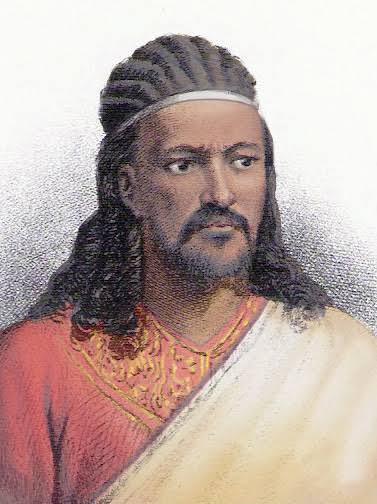
A centuries-old Gospel book that once belonged to Emperor Tewodros II — looted by British troops from Ethiopia more than 150 years ago — is being put up for sale this week at an international book fair in Abu Dhabi, reigniting a fierce debate about the repatriation of Ethiopia’s stolen cultural heritage.
The Gondarine Gospel, believed to have been produced between 1730 and 1740, is being offered for sale by Inlibris, an Austrian rare books dealer, at a guide price of €250,000 — approximately 34 million Ethiopian birr at current exchange rates. The sale is taking place between September 13 and 18 at the Abu Dhabi International Book Fair.
The manuscript is a treasure of extraordinary beauty and historical significance. Written in Ge’ez — Ethiopia’s ancient liturgical language — it contains the full text of the Gospel of Luke and all but the final 16 verses of the Gospel of John, alongside 235 paintings depicting biblical miracles and the resurrection. It has been described by the bookseller as “lavishly decorated.”
Stolen at Magdala
The Gospel’s painful journey out of Ethiopia began in April 1868, during the Battle of Magdala — one of the most consequential and destructive episodes in Ethiopian history. British forces, under the command of General Robert Napier, stormed the mountain fortress of Emperor Tewodros II. When the Emperor died that day — taking his own life rather than surrendering — British troops proceeded to loot hundreds of sacred manuscripts, religious artefacts, treasures, and royal regalia from the fortress.
The Gondarine Gospel was among them. It left Ethiopia in the hands of General Napier himself — who was subsequently granted the title Baron Napier of Magdala by the British Crown — and has since passed through a succession of private collectors, auction houses, and institutions, including the Pitt Rivers Museum, the Schøyen Collection, and the collections of Sir Paul Ruddock and Sam Fogg, before arriving in the hands of Inlibris.
It has never returned home.
“Strong Moral Grounds” to Stop the Sale
Alula Pankhurst, a renowned British scholar specialising in Ethiopian history — and the grandson of Sylvia Pankhurst, the English activist who devoted much of her life to defending Ethiopia following the Italian invasion of 1936 — has called for the sale to be halted immediately.
Speaking to The Voice, Pankhurst acknowledged that Inlibris claims there is no legal basis to challenge the sale, but argued that the moral case is overwhelming.
“There are strong moral grounds to object to the sale of this precious looted artefact that is an important part of Ethiopia’s cultural heritage,” he said. “Times have also changed and views of restitution have shifted. Inlibris should therefore pull the sale and discuss with the Ethiopian authorities and supporters of restitution to enable the repatriation of this outstanding manuscript so that it can be put on view in the National Museum of Ethiopia rather than it disappearing from the public in yet another private collection.”
The Dealer’s Response: A “Preferential Price” as “Goodwill”
In an email seen by The Voice, Inlibris offered to sell the manuscript back to Ethiopia at a discounted price — framed as a “gesture of goodwill” — while making clear that such a transaction would constitute a commercial purchase and carry no acknowledgement of any restitution claim.
The offer reads: “Should the Ethiopian Heritage Authority or the National Museum of Ethiopia wish to acquire it, we would be prepared, as a gesture of goodwill, to offer the institution a preferential price. Such an accommodation would, of course, constitute a commercial purchase and should not be understood as an acknowledgement of any restitution claim or defect in title.”
In other words: Ethiopia is welcome to buy back what was taken from it — at a discount.
In a formal statement, Inlibris defended its right to sell the manuscript, pointing to what it described as a “documented chain of ownership extending over more than a century and a half.” The company said it is “fully aware of the circumstances in which the manuscript came into British hands” but is “satisfied as to our lawful ownership.”
“No legal basis has been identified to us by which the manuscript’s present title would be invalidated, its sale prohibited, or its restitution legally required,” the statement read.
A Pattern of Plunder
The Gondarine Gospel is not an isolated case. The Battle of Magdala resulted in the systematic looting of Ethiopian cultural property on an enormous scale — manuscripts, crowns, ceremonial robes, crosses, shields, and royal regalia — much of which remains scattered across British museums, private collections, and auction houses to this day.
There are, however, signs that the tide is slowly turning. In November 2024, an ornamented 19th century Ethiopian shield — also stolen during the Battle of Magdala — was successfully repatriated to Ethiopia after more than 150 years. His Imperial Highness Prince Ermias Sahle-Selassie Haile-Selassie, grandson of Emperor Haile Selassie I, negotiated the repatriation through the Royal Ethiopian Trust, the non-profit organisation he established to preserve Ethiopia’s cultural and historical heritage. The shield had been put up for sale by a UK auction house but was withdrawn following a public outcry and pressure from the Ethiopian government.
The repatriation of the shield demonstrated that international pressure, diplomatic engagement, and public mobilisation can succeed where legal arguments alone may fall short.
What Happens Now
The sale in Abu Dhabi opens today, September 13. Unless the Ethiopian Heritage Authority, the international advocacy community, or diplomatic pressure can intervene in the next five days, the Gondarine Gospel — Emperor Tewodros II’s sacred manuscript, written in Ge’ez, painted by Ethiopian hands, and stolen from Ethiopian soil — will pass into yet another private collection, potentially disappearing from public view for another generation.
For Ethiopia, the question is not merely legal. It is one of identity, memory, and justice. The manuscripts looted from Magdala in 1868 were not just objects. They were the recorded soul of a civilisation. And they are still waiting to come home.