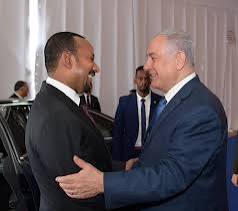
Ethiopian Prime Minister Abiy Ahmed has held a telephone conversation with his Israeli counterpart, Benjamin Netanyahu, at a time when renewed fighting in northern Ethiopia and escalating tensions with Eritrea are raising concerns about wider regional instability.
In a statement shared on his official channels, Abiy described the conversation as fruitful and constructive, saying the two leaders discussed bilateral relations and key regional developments.
The prime minister said both sides reaffirmed their commitment to cooperation on matters of mutual interest, although he did not disclose further details about the discussion.
The call comes as Ethiopia faces mounting security challenges, particularly following the resumption of fighting in Tigray and the deterioration of relations with neighbouring Eritrea.
Ethiopia and Israel have maintained diplomatic relations for decades, with cooperation spanning political, security and economic affairs. In recent years, communication between senior officials from the two countries has continued through high-level visits and diplomatic engagements.
Last week, Ethiopian Foreign Minister Gedion Timothewos also held a telephone conversation with his Israeli counterpart to discuss regional developments, underscoring the continued diplomatic engagement between the two governments.
Red Sea Rivalries Add Strategic Significance
The latest diplomatic contact comes against the backdrop of growing competition over strategic interests in the Red Sea and the Horn of Africa, where maritime access, security partnerships and regional alliances have become increasingly contentious.
Israel’s recognition of Somaliland, the self-declared state that remains internationally unrecognised by most countries, has added another dimension to the region’s geopolitical tensions.
For Ethiopia, which has been landlocked since Eritrea gained independence in 1993, securing reliable access to the sea has become a major strategic priority.
Prime Minister Abiy has repeatedly argued that Ethiopia’s lack of direct access to the sea presents a significant challenge for a country of its size and economic ambitions. His government’s pursuit of maritime access has, however, generated concerns among neighbouring countries, particularly Eritrea.
Israel’s engagement with Somaliland and Ethiopia’s interest in securing maritime access have attracted attention amid shifting alliances across the region, although the precise implications of Abiy’s latest conversation with Netanyahu remain unclear.
Ethiopia-Eritrea Tensions Raise Stakes
The diplomatic engagement also comes as relations between Ethiopia and Eritrea deteriorate sharply following renewed fighting in Tigray.
Ethiopia has accused Eritrea of sending troops across the border into northern Ethiopia and supporting armed groups fighting the federal government. Eritrea has rejected Ethiopia’s allegations and accused Addis Ababa of threatening its sovereignty through its pursuit of access to the Red Sea.
International reporting and conflict-monitoring assessments have documented reports of Eritrean troop movements into Tigray, although some details of the reported deployments remain unverified. Ethiopian forces have also advanced against the Tigray People’s Liberation Front (TPLF) and its military forces, regaining control of several strategic locations.
The confrontation has intensified fears that renewed internal conflict could develop into a broader interstate crisis.
Eritrea has also expressed opposition to Israel’s growing regional role and alleged cooperation between Israel, the United Arab Emirates and Ethiopia. Such accusations reflect the competing interests and rival diplomatic alignments shaping the Horn of Africa, although the countries’ respective security arrangements and objectives should not be assumed to form a single coordinated bloc.
Against this backdrop, Abiy’s conversation with Netanyahu has drawn attention to Ethiopia’s continued engagement with Israel as tensions with Eritrea escalate.
While neither leader has publicly disclosed whether the discussion addressed the Ethiopia-Eritrea confrontation directly, their exchange comes at a sensitive moment for the Horn of Africa, where domestic conflicts, competing maritime ambitions and changing international partnerships are increasingly intertwined.