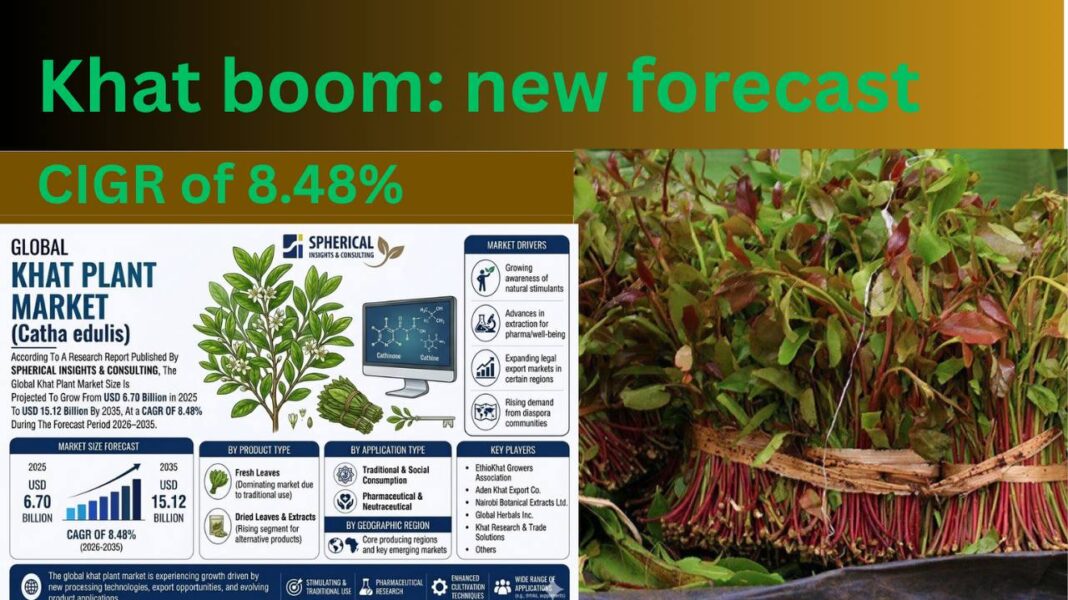
The world’s khat business is heading for a dramatic boom, with the global market projected to more than double in value over the next decade, potentially turning the traditional stimulant leaf into a $15 billion global industry.
The latest market research report by Spherical Insights & Consulting forecasts the market to expand at a compound annual growth rate (CAGR) of 8.48% between 2026 and 2035.
Khat, derived from the leaves of the Catha edulis plant, is primarily consumed in East Africa and the Arabian Peninsula, where it has longstanding cultural and social significance. The market covers cultivation and collection of the leaves as well as processing, distribution and trade.
Spherical Insights said the future development of the market will be closely linked to government policies and regulations governing khat cultivation, production and trade. Countries have different approaches to the legality and regulation of khat, making regulatory policy a key factor shaping the industry’s outlook.
The report identifies Ethiopia and Kenya among the countries where agricultural policies and investment are supporting khat cultivation. It also points to opportunities for legal producers through improved farming practices, export development, value-added processing and modernization of agricultural supply chains.
The Middle East and Africa are expected to remain the largest demand region during the forecast period. The report attributes this to established consumption patterns, distribution networks and the economic importance of khat cultivation in several countries. Growing urban populations and relatively stable consumer demand are also expected to support market expansion.
Africa is also expected to see strong growth in cultivation, particularly in Ethiopia, Kenya and neighboring countries. Spherical Insights cites rising agricultural investment, improved irrigation infrastructure, expanding domestic consumption and the profitability of khat cultivation as factors supporting the expansion.
At the same time, the report identifies Asia-Pacific as the fastest-growing regional market during the forecast period.
The market is being shaped by several broader trends, including growing demand in traditional consumption markets, expansion of commercial cultivation, sustainable farming practices and rising cross-border trade. Improvements in agricultural productivity, irrigation investment, modern cultivation techniques and supply-chain efficiency are also expected to contribute to growth.
According to the report, farmers are increasingly allocating land to khat because of its profitability compared with some conventional crops. The shift is supporting agricultural incomes and increasing production volumes. Producers are also adopting improved irrigation, soil conservation and other farming methods aimed at raising productivity while reducing resource use.
Spherical Insights’ list of leading organizations in the global khat market includes Ethiopia’s Harar Khat Producers Cooperative, Aweday Khat Trading Association, Ethiopia’s Agricultural Trading Enterprises and Oromia Agricultural Producers Union, alongside Kenya’s Meru Khat Growers Cooperative and Kenya Miraa Growers Association.
The report also identifies organizations and trading networks in Yemen, Somalia and Djibouti among the major participants in the broader khat value chain.
The research firm said the industry’s expansion could create opportunities for growers, cooperatives, exporters and distributors as agricultural production becomes more commercialized and supply chains are modernized.
However, regulation is expected to remain a major consideration for the industry. Changes in government policies affecting cultivation, distribution and cross-border trade could significantly influence the pace and direction of market growth through 2035.
With stronger agricultural infrastructure, improved irrigation, modern farming techniques and expanding trade networks, Spherical Insights expects the global khat plant market to maintain sustained growth over the coming decade.SECO