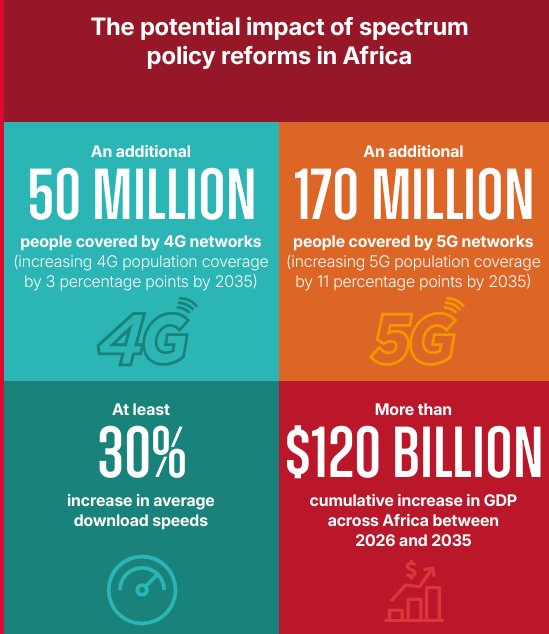
– Reforms could generate more than $120 billion in additional GDP across Africa between 2026 and 2035.
– Mobile broadband reforms could extend 4G coverage to an additional 50 million people and 5G coverage to 170 million.
– Average mobile download speeds could improve by 30–50%.
– Only nine African countries had published spectrum roadmaps as of the second quarter of 2026.
Africa could generate more than $120 billion in additional economic output over the next decade by reforming mobile spectrum allocation and licensing policies, according to a new report by the Global System for Mobile Communications Association (GSMA), which identifies spectrum management as a key factor in expanding digital connectivity and supporting economic growth.
The report, Spectrum Policy in Africa, estimates that implementing its recommended reforms across the continent could generate more than $120 billion in cumulative additional gross domestic product (GDP) between 2026 and 2035, measured in 2024 prices. By 2035, the reforms could increase Africa’s GDP by up to 0.5%.
The proposed changes could also extend fourth-generation (4G) mobile network coverage to an additional 50 million people and fifth-generation (5G) coverage to 170 million people, while increasing average download speeds by between 30% and 50%.
The GSMA argues that the benefits depend not only on making additional frequencies available to telecommunications operators but also on ensuring that spectrum prices, licence conditions and regulatory frameworks allow operators to invest sustainably in network expansion and service improvements.
Africa continues to face significant gaps in spectrum allocation. The report estimates that approximately 40% of the lower mid-band spectrum available for mobile use remains unassigned across the continent, limiting network capacity and potentially affecting service quality as data consumption increases.
In the lower-frequency bands, which are particularly important for extending coverage to rural and underserved communities, African countries have assigned an average of around 125 megahertz out of the 190 MHz available for mobile use.
The report notes that an additional 50 MHz of spectrum below 1 GHz could increase 4G population coverage by seven percentage points and 5G coverage by 11 percentage points, based on empirical analysis cited by the GSMA.
Meanwhile, mobile data traffic across Africa is forecast to increase approximately 2.6 times between 2025 and 2030, equivalent to growth of around 160%, intensifying the need for additional network capacity.
The GSMA also highlights the limited adoption of long-term spectrum planning across the continent. As of the second quarter of 2026, only nine African countries had fully developed and published spectrum roadmaps, which help operators anticipate future frequency allocations and plan investments.
The association recommends that regulators publish multi-year spectrum allocation schedules, align national frequency plans with regional and international standards, and consult telecommunications operators before finalising licence terms.
It also argues that spectrum pricing should balance governments’ revenue objectives with the need to sustain investment, improve connectivity and make digital services more accessible to consumers and businesses.
The GSMA’s broader assessment suggests that spectrum policy is not merely a technical issue for telecommunications regulators, but also an economic policy instrument that can influence digital adoption, business productivity and long-term growth.SECO