
By Daniel Behailu
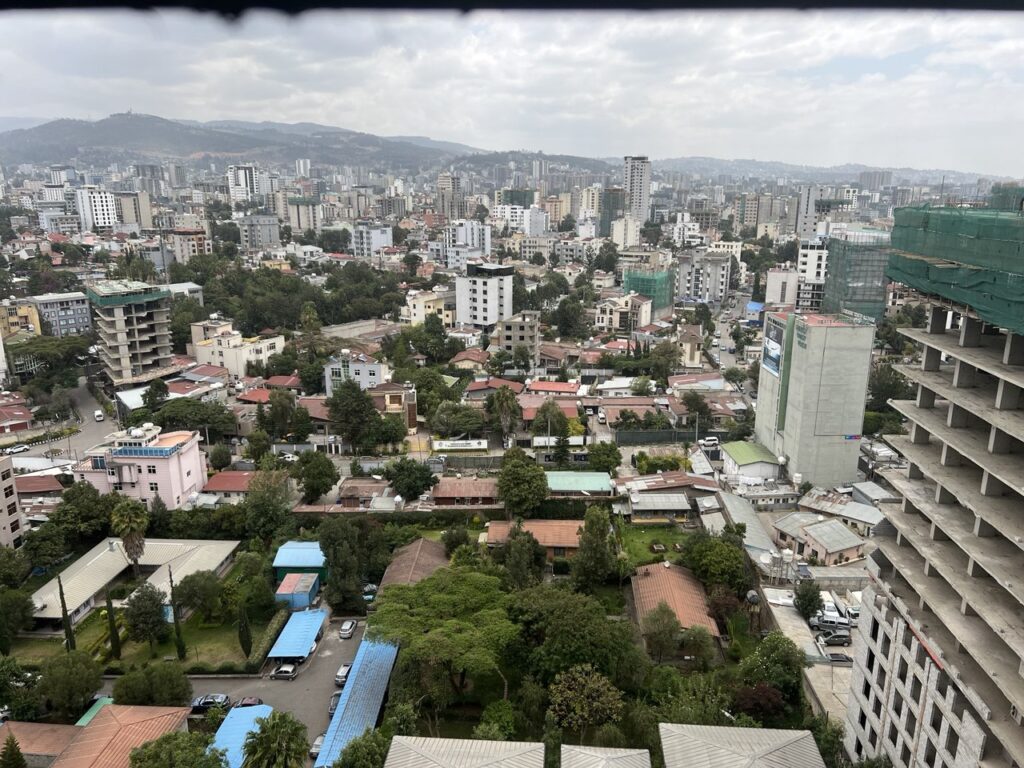
Urban concentration is often interpreted as a sign of development. In reality, excessive concentration is usually evidence of institutional imbalance. Addis Ababa’s rapid expansion is not simply the result of urban attraction; it is the spatial outcome of national policy choices. Political authority, economic opportunity, international engagement, higher education, better security, and formal employment are overwhelmingly centralized in a single metropolitan area. Under such conditions, migration becomes structurally induced rather than economically diversified.
Across the country, mobility toward the capital is rarely driven by preference alone. It is driven by access ; access to services, to decision makers, to jobs and to networks. When almost all high-value functions of the state and economy are located in one city, citizens rationally follow them. The result is predictable: congestion, escalating housing costs, informal settlements, infrastructure strain and urban underemployment inside the capital, alongside economic underutilization in regional cities.
This is not primarily a housing or transport crisis. It is a geography of governance crisis.
Urban systems function best when cities specialize. A capital city should not simultaneously operate as the sole administrative center, diplomatic hub, industrial node, education center and labor market for an entire nation of more than one hundred thirty million people.
The long-term solution is therefore not to endlessly expand Addis Ababa’s physical infrastructure, but to rebalance Ethiopia’s institutional infrastructure.
A deliberate second-cities strategy is required. This means gradually distributing national functions across multiple urban centers. The creation of an additional administrative or legislative capital should also be understood not as political symbolism but as spatial economic policy — a mechanism to redistribute opportunity and reduce forced migration.
Such a shift would generate several systemic effects. Migration would become optional rather than compulsory. Regional economies would attract investment anchored in public presence. Housing pressure in the capital would stabilize. Youth employment would emerge closer to home communities. Most importantly, national integration would strengthen as development becomes geographically shared rather than spatially exclusive.
Addis Ababa does not need to shrink, and regional cities do not need to compete with it. Ethiopia instead needs a network of complementary cities, each performing defined national functions. Development, in this sense, is not the growth of a single metropolis but the coordination of an urban system.
The policy question is therefore simple: Will Ethiopia continue building one large city, or begin building a balanced country anchored on growth than confrontations?
Daniel Behailu (Ph.D), Land Governance Policy Advisor, and Project-Component Manager at GIZ- Ethiopia