By Yehenalem Wondu
Investigative journalism has an important role to play in scrutinising major investments, particularly in sectors such as mining, where questions of land, natural resources, community interests, environmental protection, transparency and national security can intersect.
Journalists should not hesitate to investigate powerful companies, investors, governments or political actors. Indeed, credible scrutiny can strengthen public confidence in major projects.
But investigation and advocacy are not the same thing.
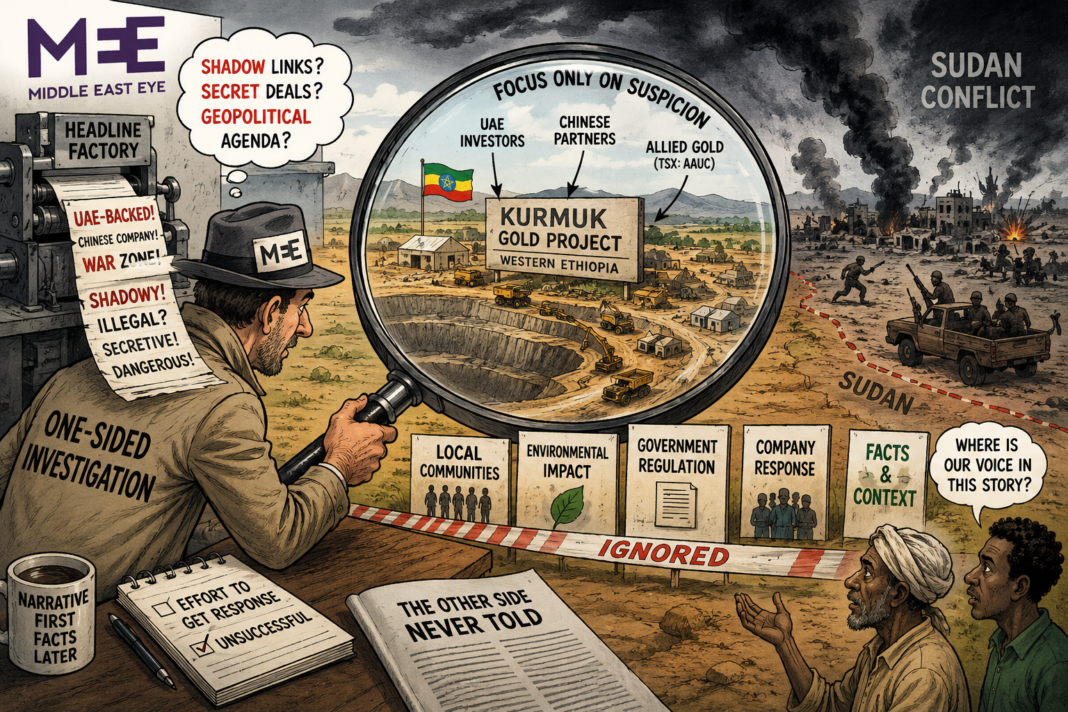
The recent Middle East Eye article, titled “UAE-backed Chinese company acquires stake in Ethiopian gold mine near Sudan war zone,” raises important questions about where the boundary lies between legitimate investigative reporting and a highly interpretive, one-sided narrative presented as news.
The approximately 1,200-word report, published in the outlet’s Africa section, attempts to portray the Kurmuk gold project in western Ethiopia as part of a broader web of shadowy political, commercial and geopolitical interests.
The subject itself deserves scrutiny.
The location is close to the Sudanese border, an area affected by instability and armed conflict, and the involvement of foreign investors in strategic natural resources is clearly a legitimate matter of public interest.
The problem is not that the project is being investigated. The problem is how the investigation is framed and presented to readers.
When the language becomes part of the argument
A fundamental principle of professional journalism is that facts should be allowed to speak for themselves. Particularly in investigative reporting, journalists should distinguish clearly between verified facts, allegations, interpretation and opinion.
In the Middle East Eye report, however, the language and narrative construction appear designed to lead readers toward a predetermined conclusion about the company, its investors and the wider project.
This is where the article begins to resemble an opinionated feature rather than a conventional news report.
Words, descriptions and narrative sequencing matter. They can subtly transform an ordinary commercial transaction into an image of suspicious activity without necessarily establishing that the underlying conduct is illegal or improper.
There is nothing wrong with asking difficult questions about a mining company. There is everything wrong with allowing suggestive language to substitute for evidence.
If a report seeks to establish wrongdoing, it should demonstrate what was done, by whom, when, how and on what evidence. If the evidence establishes only that investors, companies or governments have relationships with one another, those relationships should not automatically be presented as evidence of wrongdoing.
The importance of the other side
Perhaps the most significant journalistic question raised by the report concerns balance.
The article indicates that efforts were made to obtain responses from various parties. But saying that attempts to contact an individual or organisation were “unsuccessful” is not, by itself, sufficient to establish that the story has fairly represented the other side.
Professional reporting requires journalists to make a genuine effort to understand and present competing explanations, especially when serious allegations or insinuations are involved.
There are multiple potential sources that could have contributed to a more comprehensive examination of the Kurmuk project: Ethiopian mining authorities, regional officials, independent mining experts, local community representatives, financial analysts, corporate governance specialists, investors, shareholders, legal experts and independent observers familiar with the Ethiopian mining sector.
The absence of such perspectives can leave readers with a carefully constructed narrative rather than a comprehensive picture.
There is also a distinction between attempting to contact someone and genuinely investigating the alternative explanation they might provide. A journalist may send questions to a company, receive no response and still publish a story. But that does not relieve the journalist of the responsibility to independently test the allegations and seek credible alternative sources.
Investigative journalism must not become a “propaganda bomb”
This issue extends beyond one article or one media organisation.
International media have enormous influence over how African countries, businesses and political actors are perceived by audiences outside the continent. A report published by an internationally recognised outlet can quickly become a reference point for other media organisations, social media commentators and policy communities.
That makes responsible reporting particularly important.
There is a long history of international reporting on conflicts in the Middle East, Syria, Ukraine, Sudan and Ethiopia in which competing narratives have sometimes been presented through highly selective framing.
Different media organisations naturally have different editorial perspectives, but the existence of an editorial position should not undermine the basic journalistic obligation to distinguish evidence from interpretation.
The Ethiopian experience provides numerous examples of how international and regional media narratives can shape perceptions of events on the ground. Coverage of the northern Ethiopian conflict, for instance, generated intense debate over the accuracy, balance and sourcing of reports produced by international media outlets.
The lesson should not be that journalists should stop investigating controversial subjects. The opposite is true. They should investigate them more rigorously.
The Kurmuk project deserves scrutiny—but also context
The Kurmuk gold project is located in a particularly sensitive geographic environment. Its proximity to Sudan means that legitimate questions can be raised about security, cross-border trade, regional instability, supply chains and the protection of communities.
These questions should be investigated.
But the existence of geopolitical risks surrounding a project does not automatically mean that the project itself is politically motivated or involved in illicit activity.
A mining company operating in a difficult region may have commercial reasons for entering the market. Investors listed on international stock exchanges have obligations to shareholders and are generally driven by commercial considerations, although this does not mean that corporate misconduct should be ruled out in advance.
The appropriate journalistic question is therefore not: Who is secretly behind this project?
It should first be: What does the evidence demonstrate about the ownership, financing, operations, contracts, regulatory compliance and economic interests involved?
That distinction is fundamental.
Follow the money—but follow all of it
If the purpose of an investigation is to understand who benefits from the Kurmuk project, journalists should indeed follow the money.
They should examine ownership structures, beneficial ownership, financing arrangements, corporate filings, licensing agreements, shareholder interests, government contracts and financial disclosures.
But the same standard must be applied to every party.
If foreign governments, companies, investors or political actors are alleged to have strategic interests in the project, those claims should be supported by documentary evidence rather than inference. If there are competing commercial interests in the region, those should also be examined.
Most importantly, journalists should ask whether the evidence demonstrates an actual connection or merely establishes that two actors operate within the same geographical or commercial environment.
That distinction can determine whether a report is investigative journalism or speculation.
Who benefits from the narrative?
It is reasonable for readers to ask why particular aspects of a project receive intense media attention at a particular moment. The same question can be asked of any major investigation.
However, caution is required here as well.
Claims that a media organisation is acting on behalf of a particular government, religious movement, political group or financial interest should themselves be supported by evidence. It would be inconsistent to criticise one-sided journalism while making unsupported allegations about the motives of the journalists involved.
Middle East Eye has its own editorial perspective and history, and its coverage of Middle Eastern politics is often strongly critical of certain governments and political actors. But determining whether a specific article was commissioned or shaped by a particular outside interest requires evidence beyond the content of the article itself.
The stronger criticism is therefore not to speculate about who is secretly driving the story, but to examine what the story demonstrates, what it fails to demonstrate and whose perspectives it excludes.
That is a much more defensible journalistic critique.
A wider media campaign?
The Kurmuk project has reportedly attracted attention from various local media platforms, social media commentators and other publications, with some coverage portraying the project and its investors negatively.
The existence of multiple critical reports does not automatically establish a coordinated media campaign. Nor does repetition of a particular narrative prove that the narrative is false.
But it does justify a broader media-literacy question: Are different outlets independently reporting new evidence, or are they repeatedly reproducing the same assumptions and allegations?
That distinction matters enormously.
A claim repeated by ten media organisations remains only one claim if all ten obtained it from the same original source.
Professional journalism should add new evidence, new sources and new perspectives—not simply amplify an existing narrative.
The public deserves more than suspicion
Mining projects in developing countries require serious scrutiny because they involve public resources and can have long-term consequences for communities and national economies.
The right response is not to shield such projects from investigation. It is to demand better investigation.
A professional report on the Kurmuk project should examine the government’s licensing process, the company’s ownership and corporate structure, the terms of the investment, the expected economic benefits, employment, community relations, environmental safeguards, security arrangements, tax obligations and the legal framework governing the operation.
It should also speak to people living in the area.
Local communities should not merely appear in a story as background scenery for a geopolitical narrative. Their voices should be central. What do they expect from the project? What concerns do they have? What benefits have they received? What environmental or social risks do they identify? What does the company say in response?
Those questions would produce journalism that is considerably more valuable to the public.
The real test of investigative journalism
The credibility of investigative journalism does not come from the seriousness of its accusations, the international reputation of the publication or the dramatic language used to introduce a story.
It comes from evidence.
A genuinely strong investigation should survive scrutiny from the people it investigates. It should present uncomfortable facts even when those facts weaken the journalist’s preferred narrative. It should give subjects a meaningful opportunity to respond. It should distinguish allegation from fact, suspicion from evidence and interpretation from verification.
The Kurmuk project may ultimately prove to have problems that deserve exposure. It may also prove to be a legitimate commercial investment operating within Ethiopian law. At this stage, neither conclusion should be predetermined by the language of a media report.
The responsibility of journalism is to establish what is true—not to decide in advance what the truth should be.
That is why the Middle East Eye report should be read critically, not simply because it is critical of a major Ethiopian mining project, but because every investigative report—particularly one involving geopolitics, foreign investment and a conflict-affected region—must itself be subjected to investigation by its readers.
The most important question is therefore not whether the Kurmuk project deserves scrutiny.
It unquestionably does.
The more important question is whether the scrutiny being offered is rigorous enough to deserve the public’s trust.
If an investigation relies heavily on insinuation, selective framing and limited representation of alternative perspectives, it risks becoming advocacy dressed as journalism. And when internationally influential media organisations do this in countries such as Ethiopia, the consequences extend beyond one company or one investment. Such reporting can shape perceptions of an entire country, its institutions and its ability to attract legitimate foreign investment.
Africa needs more investigative journalism, not less.
But it needs journalism that investigates everyone, follows all the evidence, listens to all sides, and allows readers—not journalists—to reach the final judgment.
Thank you!
Editor’s note:
The views expressed in this article are not necessarily those of etbusinessview.com (EBV) or its editorial policy,but solely those of the writer. Picture: AI generated
You can contact the writer at eastafricasun@gmail.com