A word that was supposed to be a punchline has become a campaign.
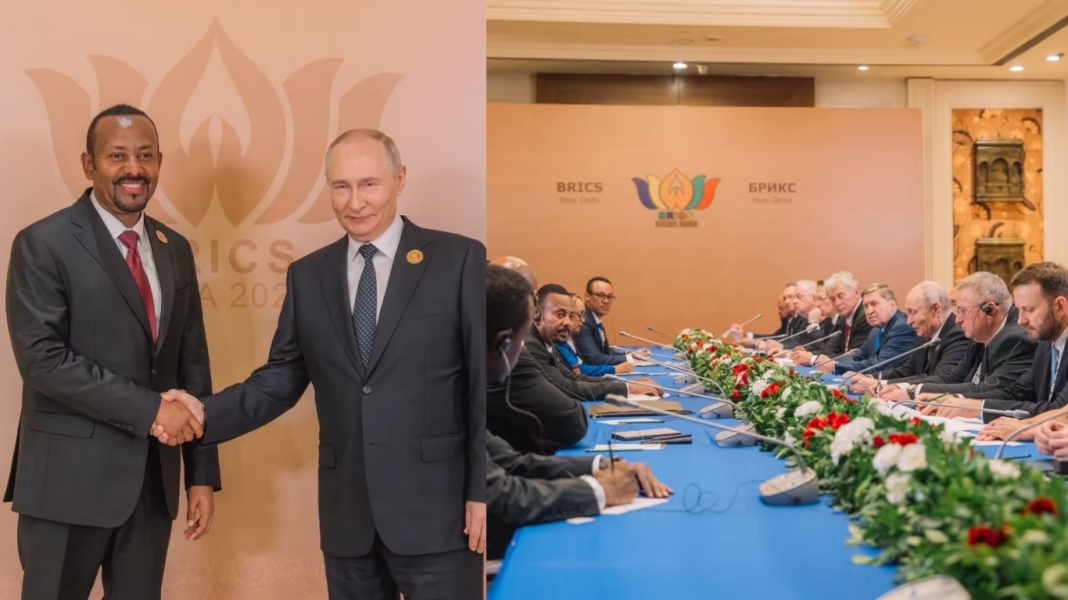
During the BRICS summit in New Delhi this month, Ethiopian Prime Minister Abiy Ahmed made an unusual joke while speaking about Russian Foreign Minister Sergey Lavrov’s visit to Ethiopia.
Lavrov, Abiy explained, had arrived in Ethiopia in 2026 but had effectively become seven years younger because Ethiopia follows a calendar that is seven years behind the Gregorian calendar. Abiy described it as a “seven-year discount.”
Donald Trump and “covfefe”
The joke was easy enough to understand. The choice of the word “discount,” however, immediately became the object of ridicule on Ethiopian social media.

For days, social media users played with the phrase, questioned the English and turned “seven-year discount” into a joke of its own.
Then something unexpected happened.
The Prime Minister’s Office did not shy away from the phrase. Instead, it turned “seven-year discount” into a playful tourism pitch: come to Ethiopia and feel seven years younger. The promotional video presents Ethiopia’s calendar difference as a reason to visit, transforming a phrase that had become a subject of online mockery into a lighthearted invitation to experience the country—and, quite literally, turn back the clock.
Instead of distancing itself from the phrase, the Prime Minister’s Office embraced it.
The move is interesting not because the original wording was perfect. It wasn’t. It is interesting because of what happened after the criticism.
The internet had created a joke. The government decided to use the joke.
That is increasingly becoming a communications strategy in the age of social media: if people are already talking about you, sometimes the smartest response is not to stop the conversation but to take control of it.
From embarrassment to ownership
Traditionally, public figures have treated ridicule as something to suppress.
A politician makes a verbal mistake, and his communications team issues a clarification. A celebrity is mocked for an appearance, and publicists try to change the subject. A company receives an embarrassing nickname, and lawyers may become involved.
Social media has changed the calculation.
Once a joke has escaped into thousands of conversations, trying to erase it can make it bigger. But adopting it can change the relationship between the person being mocked and the people doing the mocking.
The joke is no longer entirely theirs.
The person being mocked can say, in effect: Yes, I saw it. And now I am going to use it too.
That is what makes the “seven-year discount” episode worth watching.
It is not necessarily an admission that the criticism was wrong. Nor does it prove that everyone involved in the original joke suddenly approved of Abiy’s English.
It is something simpler and, from a communications perspective, potentially more powerful: reframing.
And there are plenty of international examples.
Donald Trump and “covfefe”
Perhaps the most famous example involving a politician is Donald Trump’s 2017 “covfefe” tweet.
Trump tweeted: “Despite the constant negative press covfefe,” leaving millions of people trying to work out what the word meant. Most assumed it was a typo for “coverage.”
The internet did what the internet does: memes followed, news coverage followed the memes, and “covfefe” became a global joke.
Trump could simply have admitted that he had made a typing error.
Instead, after deleting the original tweet, he asked: “Who can figure out the true meaning of ‘covfefe’?”
The White House press secretary at the time even suggested that Trump and a small group of people knew what he meant.
The joke became a cultural phenomenon. “Covfefe” was subsequently used in merchandise, political commentary and even the name of proposed legislation concerning the preservation of presidential social-media posts.
Trump later returned to the word himself, jokingly invoking “covfefe” again in a White House video.
It was a remarkably Trumpian response: don’t surrender the joke to your critics; make yourself part of it.
Of course, “covfefe” is not a model of careful political communication. But it demonstrates something important about the attention economy: an embarrassing moment can become an asset if the person at the centre of it refuses to behave as though embarrassment is the only possible interpretation.
Taylor Swift and the “haters”
Taylor Swift took a different route.
For years, Swift was subjected to intense scrutiny over her relationships, personality and public image. Rather than simply answering each criticism individually, she turned the broader experience of being criticized into music.
Her 2014 hit “Shake It Off” was explicitly about dealing with negative criticism.
In a later court filing, Swift described the song as drawing partly on her experience of relentless public scrutiny, clickbait reporting and negative personal criticism. She said she wanted the song to offer a humorous and empowering way of dealing with criticism through music and dance.
The important thing here is that Swift did not attempt to win every argument.
She changed the frame.
Instead of asking whether every criticism was fair, she turned the existence of criticism itself into part of the artistic message.
The criticism became material.
That is a different kind of reclamation from Abiy’s “seven-year discount,” but the underlying principle is similar: take something being used against you and decide what it means.
Barack Obama and the tan suit
Sometimes the criticism is so absurd that the best response is simply to laugh at it.
In 2014, Barack Obama’s decision to wear a light-colored tan suit at a White House press conference became an unexpectedly enormous political controversy in the United States.
The criticism was widely mocked as an example of political media and public discourse becoming obsessed with something trivial.
Obama eventually joined the joke.
White House staff later referenced the suit on social media, while Obama himself joked about it at public events. At his final presidential news conference, he said he had been tempted to wear a tan suit again.
The lesson is subtle.
Obama didn’t need to prove that the tan suit was fashionable. He didn’t need to convince everyone that the controversy was stupid.
He simply took ownership of the joke.
Once the target of ridicule participates in the joke, the power relationship changes.
When the meme becomes the marketing campaign
The phenomenon is not limited to politicians and celebrities.
Brands have become particularly good at turning internet jokes into marketing.
When an object or celebrity becomes a viral meme, companies increasingly try to enter the conversation rather than watch from the sidelines because they understand the internet had done the difficult part: People were already talking.
All the brand had to do was join the conversation quickly enough.
The danger of trying too hard
There is, however, a difference between owning a joke and desperately trying to manufacture one.
Audiences are very good at detecting the latter.
The strategy works best when the original criticism has already generated genuine public interest. It also works when the response feels confident rather than defensive.
That is why the Ethiopian “seven-year discount” case is interesting.
The Prime Minister’s Office did not need to convince Ethiopians that the phrase was suddenly conventional English. Nor did it need to pretend that social media had not noticed it.
It effectively did something more practical:
It took a phrase that people had already made memorable and made it useful.
Whether the campaign will have a lasting effect is another question. But the communications logic is sound.
The internet mocked “seven-year discount.”
Then the phrase appeared in an official government video.
What happens when public figures choose to embrace the criticism instead of fighting it?
From Ethiopia’s latest social-media episode to Donald Trump’s “covfefe” and Taylor Swift’s response to years of criticism, this article explores how politicians, celebrities and brands have turned ridicule and embarrassing moments into attention and sometimes, an advantage.
When the internet gives you a joke, use it.
Editor’s Note: This article is a reader’s opinion and does not represent the position or editorial views of EtBusinessView.